 |
|
Fig 1 The evolution of an economy to stability |
The lasting way to stabilize wealth… attracts those who like ideas just for their beauty. It comes with unfamiliar cultural changes, even letting go of trusted old ideas of our growth culture, to respond to needs of things outside itself that had no meaning before, both the natural working limits of its previously 'unimportant' parts and its previously 'unimportant' environments. Responding to things 'outside' the system is what fills in what's missing from it, by being responsive to things other than itself. Examples of how that's done are all over, within us and around us.
Growth systems in nature don't need to fail.
They can also finish, and leave a perfection of completed design rather than a shambles of struggling parts in their wake, with only their misery to connect them. That's been the climax product that so many human complex societies of the past have produced, as their culmination of their growth, the "towers of Babel" and "Roman Empires" of history [Rome & Babel]. What the error seems to be... is not changing plans.
What's hard about it is gaining the perspective, a view of our choices that is not predetermined by our emersion in a dominant technological society with very ancient roots of not understanding this particular counter-intuitive, but not so vary complex problem. As also demonstrated by the prevalence of financial bubbles, economic panics, frequent wars of global conquest, modern culture has ancient roots and a very long standing 'tradition' of not understanding natural limits of growth and the simple choices .
The kinds of natural growth systems that succeed in perfecting themselves gracefully, and then display long histories as mature stable organisms, economies, cultures, etc., have another way of responding to limits. They don't measure their progress in terms of % change in the rate of their expansion. If they appear to be systematically doing that during their initial periods of explosive compound growth, busy inventing ever more productive new strategies, they then also appear to abandon that "rule" quite casually when inventions for increasing scale start becoming a burden and inventions for completing their designs and finding a comfortable fit by building new relationships with one's environment remains to be done.
In figure 1 that is the "Point of changing values" where building by %'s in proportion to the past switches to building by %'s in proportion to the future. It corresponds to a "graduation" from immature expansion of self-interests to maturing and refining internally and externally, ending in a stable new role in the world at large and a lasting peak of vitality. Nature displays a kind of responsiveness, an ability in its most self-centered systems of all, to give that up casually on the first distant hint of trouble, and not wait for collapse as a signal to change.
10/7/10Stabalizinig wealth and letting go of adding by %'s would also give us time, even if we don't do it as smoothly had we understood the problem a hundred years ago when it seems we made what amounts to our fateful choice! We could symbolize that choice with any number of ways history shows the 1910's as a marker in mankind's hunger for power and control and having it completely get out of control. This discussion focuses on the "other face" of J. M. Keynes, how the system's ecology approach that let him invent a way to stabilize finance in the 1930's also included the real lasting solution to the instability the economies face today. He also saw our present problem coming, described the true solution, but it was completely ignored.
Most Others did non see why economies would ever meet limits of diminishing returns, bringing on credit contractions as we now have. Keynes saw we could be mature about the end of growth, and just turn off the central mechanism that runs out of control without continual growth, the savings of people who have more than they need, that no one can use unless to expand them by %'s. Now the numerous ‘crises of capitalism’ we face are global and quite dangerous; ‘peak food’, ‘peak oil’, ‘peak extinction’, global warming, etc., with worse to come. That's not to mention the developed economies which were built to need ever cheaper resources becoming unable to compete with with economies developing our new world of expensive resources. Popular culture even clings to the idea that we can grow out of any pinch. That ignores how the erupting consequences caused by going too far already will just get worse.
The "other choice" than just continuing to make our problem worse
is most easily described as showing the people with more financial savings than they actually need that they'll stop making money
unless they spend or give enough away to stop increasing their savings.
The economy is choking from too much money collecting in one place relative to the mounting severe complications of now actively spoiling the bounty of the earth. It also is the critical step for diverting the surpluses of the economy to better use than feeding the money pumps that were always the source of over-inflating expectations to the point of collapse. Keynes called his 'sustainable design' for economic climax “the widow’s cup”, after a story of Elijah granting a widow an inexhaustible jug of oil [Widow's Cruse].
It’s also the way businesses and natural systems stabilize after growth.
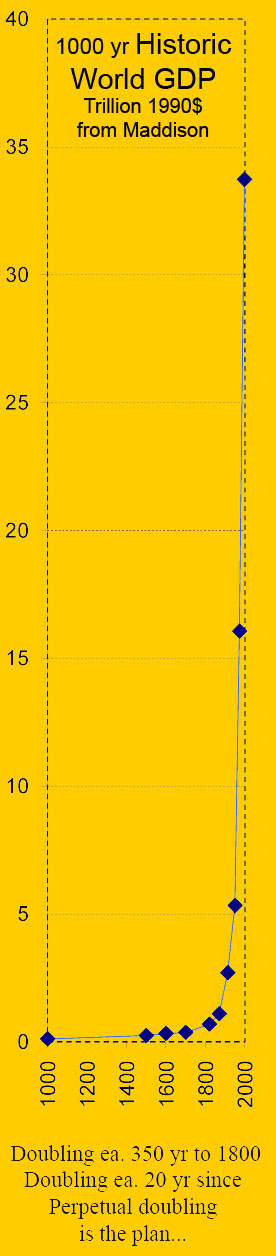
Keynes’ idea was not understood, and also objected to since it would end the automatic concentration of wealth. Continuing on the learning curve of past World GDP growth (1) is both highly immature and not at all viable. Diverting surpluses from growth would be our first act of maturation, as all successful efforts end their creative explosions. Whatever you call it, it would give humanity time to think without pumping up our problems, and maybe provide some resources for our great unfunded needs.
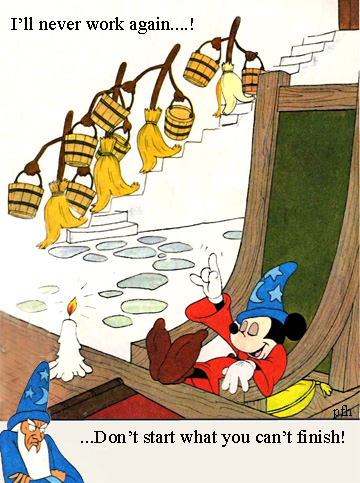
5/30/08Still, proposing to use nature’s method of maturing, turning growth toward stabilizing our new relationship with the earth, is so very different… you may even need to think! ;-) If we just ‘wait and see’ our immaturity will determine our limits with mounting crises. Like ‘the sorcerer’s apprentice’2, we need desperately to find how to switch off our prize invention, requiring a hint, to not waste time, and then to continue to ask open questions.
It’s a stunning choice, a fork in the road. Nature offers plentiful examples of both ways of solving this classic choice of development paths, but almost no one has studied them as a science. Developmental paths are individual constructions, and established science is not a method for studying individual development paths. To study development paths you need to ask pointed questions as they change. Development paths are learning processes of their whole local environment. Sometimes they follow their least resistance, sometimes their discovered opportunity. It’s a different kind of science.
0  1
1  2
2 3
3  4
4  5
5 6
6
The whole story of any play
The trick to seeing how things develop is to read growth as local path making in a whole environment learning process. The path found is what determines natural system designs. Business plans explore many directions to find one to pursue. In the story of mankind we are at point 2 having a good plan to complete. After the magical point of germination 1 every growth system finds expansion easier and easier, until it gets harder again from running into things. In period 1 ever bigger work is done but that runs into complication. After point 2 bigger jobs turn into smaller ones again, either by finishing, or failing at, the big ones. That’s the choice. There is no other.
Looking at it from nature's point of view, a new guest in her house that doesn't know their own business is unwelcome. Diminishing returns is the signal she gives any new guest at some point, to see what they are able and interested in learning about the rest of her family. Depending on what they do learn she then allows them to stabilize or causes them to collapse, to make room for better bets of other kind. The family of life is a extremely elite community. From the very lowest to the highest forms, all are marked by needing and being able to become responsive parts in the whole, or be dropped and recycled. It's something like a matter of housekeeping.
There's a great deal to think about, and rethink, when the central purpose of economic prosperity turns out to be a profound mistake... We need time and new perspectives. One place to start is with wondering why in some situations people are so good at completing and connecting things, and very sensitively aware of the rude rejections we otherwise might naturally run into. In others we just crash right into obvious tragedy as if we didn't even understand the concept of 'look ahead'. Our blind spots are so blind and our clear spots so clear there must be something in it for us to discover. One of the lines between those two kinds of perception seems to be between where we directly watch 'what's happening' and where we just watch the world with 'our rules'. Rules can't show the environments they run into.
My research methods for natural systems amount to closely watching the flow of change to see when to ask the basic developmental questions. When the flows of events are changing scale exponentially you'll also find networks of relationships that are doing it. The basic questions are to ask where those networks started, what they'll run into, and where they'll end end. Most sorts of natural events include these periods of change and instability in environmental relations. A it's a 'wink' or a 'typhoon', the development necessarily follows it's own developmental path, and goes through the same primary switches. This approach does not makes all of nature's revolutionary redesign methods understandable, as if providing a rule for them. What it provides a rule for is where to go to discover them. It raises flags as to when something is going to happen. For example, I've been writing for years that using 'renewable resources' to replace fuel from a hole in the ground would have multiplying impacts by consuming other essential land uses in an non-renewable way. I could see it would run into trouble a long way off.
What I missed was predicting what the first major trouble would come from how corn-ethanol would contribute to triggering a permanent world food crisis. I was quick to see the larger connections once it started happening, but only foresaw that our multiplying footprints would produce multiplying conflicts to catch us completely by surprise. The conversion of land to fuel production from food caused by increasing use of ethanol is actually only a small part of what is consuming our food producing capacity. It's really the whole urbanization of the earth that is taking land out of food production while increasing food demand. What price wars represent is new rigidity in the supply and demand relation, i.e. structural limits. We've used up so much food producing capacity that supply could not respond to increasing demand, and demand was then not reduced to equal supply until enough people couldn't afford to buy food. This information and the logic are simple and clear, but easily missed, and their dire consequence are often 'hidden in sight'. Asking the basic questions above of 'what's developing' helps you actively search for them.
Every kind of developmental process runs out of or into something. It’s as certain than sunrise. They're 'cycles' made of real chains of partly deterministic and partly opportunistic organizational imbalances that store up and release. They're like organisms, and will always 'run out of' or 'upset' other things as they develop, and then change the direction of their development. I find it most helpful to consider them as 'exploring' their own environments. For subjects we can come to know as 'second nature', like driving a car, we'll automatically look to see what each turn will run into and be sure to have all the controls in good working order. For things the 'plans' we make, more frequently we don't look at anything in the environment at all but our fixed pre-conceived image of some opportunity that was our reason for making a plan. That seems to be what happened when the environmental movement promoted 'bio-fuels' as a 'renewable resource', and didn't notice it would trigger a world price war for food by non-renewably consuming growing amounts of land. With the one kind of learning we see these things coming remarkably clearly. With the other kind it's like we're flying completely blind. Reading the data for where balances are about to become upset can alert us to some of the missing issues. It also seems to be a natural source of information about what to watch out for that all living things naturally pay attention to. It's about getting things started, avoiding collisions, preventing things from ending; finding your way in a complex world full of independently behaving parts.
Rule #1 in this is one of the ones we most easily miss... that multiplying good would naturally turn to multiplying harm, if we don't look out for the point of 'enough' and switch to other purposes. Ideas of 'good' are often fixations we don't revisit as the environmental responses change. You'd ideally just update your definition of 'good' once you see diminishing returns in some larger sense. In the case of money we have not seen any need to do that, being selectively blind to how our multiplying personal 'good' has been doing tremendous harm to the earth.. My version of Keynes 'Widow's cup' is a feasible way to actually redefine the legal meaning of 'good'. That is by changing the legal rule that defines 'good service' and fiduciary responsibility for investment managers, the "prudent man rule". Presently the "prudent man rule" is interpreted as requiring managing other peoples money for maximum compounding returns. It would stabilize economic development to reinterpret the word 'prudent' in it's more general original sense. Given that the automatic compounding of returns is now causing damaging the earth, turning multiplying good into multiplying injury, it would be necessary for investment managers to return all earnings to their owners for their prudent use for good works of their choice that do not produce returns. Absent that net effect all economies are unsustainable.
We have lots of rules and practices for business to prevent behavior that threatens the business system as a whole. They become largely self-enforcing since no one wants to do business with people who cheat. How to gradually introduce this way of stabilizing money would begin with discussing it. It would be an unprecedented kind of change, but so are the exploding conflicts resulting from our collision with our physical limits. Once there's a plan we'd watch to see what else needed to be changed as it developed. It would obviously require a lot of people to carefully study their own needs and options. It's very big change, but could leave wealth undamaged. Just waiting around until our multiplying conflicts produce a final crash won't achieve that. It would also gradually redistribute wealth according to service rather than just concentrate wealth in proportion to concentration. In all likelihood a lot of debt is predicated on future growth, forming an endless spiral of repayment commitments. Absent continually growing profits, a significant part of current profits may need to be spent on retiring debt.
As you check this out, if it holds up, perhaps consider it as a clue that our blinders are so very selective. Our minds are full of stereotypes, ancient myths and gossip, for example, that we use without checking. Some places we seem to cling to them, some places we're completely free of them. When we then think in terms of those images what we miss out on is the whole physical world full of separately designed and behaving parts. It's a mismatch of huge proportions between the real world in which we live and some of our mental 'crutches'. When these fixations are passed on to us from someone else 'second hand' we don't even know how to validate them. In using them we see only their implications and fail to ask how the things they refer to might actually behave on their own. Scientific models can be especially problematic, representing the world as not having any separate parts, just numbers all following rules that represent similar things as all following the same rules. That's simply not what happens in an environment. Everything with a development path is making it's own with it's own local responses. They generally develop in quite new ways and responsively to each other. Just increasing the uncertainty of one's predictions tells you nothing of what is happening in particular. Nature is built of individual things, that swarm in communities of individuals learning from each other. They're all different, not just in the path they leave, but in how they make it. That the parts of natural systems are inventing new paths as they go lets them lead each other, and that's how major departures from our rules develop. Rules of expectation can then either hide local departures from us, or alert us to them, depending on whether we treat the = signs as including either large or small ? marks. When the discrepancies you see start telling a new 'story', then the basic questions about its natural developmental sequence give you a map for how to explore it.
Some things follow what seem like universal laws of behavior rather well. Others are so individual in behavior that considering them as a group erases all the insight you could gain by paying attention to them as individuals. Where the error of describing individual behavior with rules is glaring people tend not to use them, of course. It would be like hoping to see your own true self by overlapping all your family photos. You'd just get a 'blur', as everyone's individual face treated as a random 'error' that distorts the 'true' distribution of shapes. An average, of course, just erases the particular. Doing that is the first principle of the scientific method, as it has stood, intended specifically to distract attention from the particular. Nature's method is to handle absolutely everything in particular directly, just leaving it up to us to ponder. It may be unintended, but conventional science technically denies the meaning of everything in particular. That we have not noticed that there's a rather substantial difference, suggests just how much we have to learn. One of the places it really matters is in understanding how conflict develops. Conflict develops as a particular local interaction between individuals. One kind we are now seeing a lot of is how growth limits produce widespread internal conflict. At the limits of growth what used to be independent parts with freedom of movement (space in-between) all run into each other, more or less all at once. Up to that point they were all successful in avoiding conflict.
The key to why growth limits trigger suddenly spreading conflict is that each part reacts independently. Each avoids conflict as long as possible. When an economy or other natural system acts as a whole ripples of change begun anyplace travel everyplace. That means that degrees of freedom adjust widely so that all reach limits at the same time. Everyone uses uncontested resources by preference. When the environment runs out of uncontested resources a system that always uses it's surpluses to multiply it's numbers forces all it's parts to begin to take resources that others have already laid claim to. Thus we have now have 'hunter gatherers' consuming endangered species for survival and 'sustainability' advocates consuming agricultural land in a way that triggered putting 100 million people in jeopardy of starvation. Both just naturally 'stumble' into these mortal conflicts at the natural limits of uncontested resources. It's actually an excellent reverse indicator, a clear forecasting signal, that system wide increases in conflict indicate entering an advanced stage of colliding with growth limits. Diminishing returns and other measures of how much more effort it takes to avoid conflict provide longer term forecasting of 'enough'.
Fortunately these signs what we're missing also have the unintended side effect of pointing to possible hidden treasure too. The end of growth 2 is not just a sign of needing to declare a truce in our war with ourselves. There's another opening entirely. The end of compound growth in living systems coincides with the beginning of their real lives, not the end; their leaving the shell, or womb, or nest; their moment of 'birth'. For any system that 'gets it ' that switch from self-interest to joining one's interests with those of the life around it begins the main show and the start of their long an prosperous future. A great oak tree makes that switch when it has it's first two little leaves, switching from exponential growth draining the food in it's seed, to seasonal growth in keeping with and becoming part of its environment. For animals, including humans, developing from a single cell the end of growth corresponds to breaking the shell or being born, the beginning of maturation. It's very odd we didn't notice this altogether obvious pattern of individual events quite some time ago.
You’ve probably noticed that our environmental and economic dilemmas are increasing in number, urgency and complexity. What will follow depends on how persistently we continue to accelerate the depletion of our many diminishing resources and freedoms. You may have also noticed that despite very strong and clear signals from what the scientists can predict, responses to our crises are faltering. The ability of the public to pay attention to our increasingly sever problems is decreasing not increasing. Given the magnitude of the problem, we apparently should have started changing our technology to avoid global warming at least 50 years ago, for example. Now we're so dependent on high energy use many of our communities may not be able to adapt. There's huge opportunity cost in not paying attention!
It's very difficult to calculate, but our present delay in paying attention to the problem seems likely to represent lost opportunity on the order of Trillions of dollars a month. Development paths are non-repeatable processes. We can not go back. We need extremely high confidence strategies for preventing major and lasting damage to the earth and the economies. By defining the problem as removing bottlenecks for growth we are getting the opposite. What we're getting is ever lower confidence strategies for explosively increasing the complexity of solutions, and a public that can't pay attention because it's too confusing. The complexity of solving the problems of our collision with the limits of the earth are getting ever more unmanageable, to the point where scientists are unable to explain them. Naturally people loose interest, and that should be a sign. If the problem has become too confusing to follow, the risk of failure is all but certain. You might find other aspects of the subject discussed on my main web page or following the links below.
It does 'depend' but mostly on how stubborn we are about accelerating the exhaustion of our many kinds of diminishing resources and freedoms. There's one central control point. What we need to avoid, in systems development terms, is organizational collapse at our peak rate of expansion. We need to not be rejected by our host, and have her use her last defense of collapsing herself to shed our offending aggression. She can rebuild from that, we couldn't. We need to have the global economic system fail to accelerate the consumption of it's 'seed' resource to an impasse, and fail to become rooted and sustainable. It's a very genuine threat, and a calamity from which it might not be revived. Both the Mayan and Easter Island civilizations appear to have collapsed abruptly at their own peak rates of growth, for example. Those and a great many other civilization collapses closely match the characteristics of our perverse response to limits, attempting to 'sustain' ourselves by accelerating our use of diminishing resources (2). As far as we have heard the message, we're still responding in all the wrong ways, simply because all we can think of is 'multiplying good', an burning out every real opportunity to 'make good' we have.
People are still talking about both making radical changes to what we already built, and also continuing to accelerate our expansion. The direct effect is naturally to drive up the prices of depleting resources radically higher and higher. It may not progress steadily, but that approach is terminal. The politicians and the public are completely unaware. Less productive people are getting progressively squeezed out as highly productivity people take over ever more of declining resources. It's almost like gangrene, a progressive die-back starting on the low productivity fringe, but for us done to enrich the center. That's a bad plan. It works it's way up from the extremities making essential resources ever more expensive and progressively shutting off millions of less productive people and their communities. It's a direct and certain consequence of a growth system hitting unresponsive physical limits, a problem of our definition of good we can't solve. The prosperous core of the economy will appear to thrive on it temporarily, but then inevitably collapse. As it efficiently exhausts its own resources it unavoidably would succumb to widespread internal conflict that spawns..., and so mirror the collapses due to diminishing returns of most complex societies of the past. Our collapse might be far more lasting than people have yet imagined. At a certain point we would not be able to use our complex organization to rebuild, nor have the any record of how it was supposed to work, except by starting over. We'd could find ourselves trying to start over without any seed of cheap resources to do it.
Barreling ahead on our path is a bad plan… and having a little time might help us study it. People who care about the beauty of ideas may see our dilemma as a classic risk of rejection in a new relationship, a failure at the transition from growth to maturation from being overly aggressive and not heeding the new partner's response. It's a transition that every successful system in nature survives and discovers how to thrive for doing so. It’s a naturally vulnerable time, switching from multiplying ever faster on non-renewable resources to stabilizing and fitting in with renewable ones. The transition from growth to maturation coincides with the time of birth for organisms that grow from a seed or a cell. It is also a time when attempted births often naturally fail, a point of danger for seedlings which at that point tend to wilt, for newborns that die or new ventures that stumble and exhaust their visionary seed. We may not make it. Some things with developmental paths with these features are easier to study, like business plans, home repair or vacation plans, and starting new personal relationships. They all display the need for a multiplying seed and free resource, the dangers of overshooting and being unresponsive to the environment they all unavoidably discover surrounding them. These types of personal plans and experiences have an advantage in that we all deal with lots of them and so we see the details and have a wealth of insight into how they make the transitions. Experiencing complete rejection and failure from misjudging what's 'enough' is common to them all too, as well as the sweet satisfaction after sweating the details of getting it right. The beauty of making that transition, facing the need to yield some thrill of ever greater achievements in furthering an old image, and change one's entire way of looking at change, is a lot to give up. Everything that succeeds does it though. I has all the fearful and joyful parts of 'graduating' from one world to enter a whole new one. Despite the trauma it really can be, if successful that transition is invariably seen later as the beginning of a greater experience of life, not the end.
Walter Lippman offers a lucid exploration of the dysfunction of political thought in his book Public Opinion(3). He ends his discussion of how political thinking in the decade before 1921 was derailed by leaders being unable to avoid their stereotypes of change by recalling Plato's appeal to true reason in the Republic. The way I'd say it is only a little different. I'd say politics will never work until it is a profession of 'teaching and learning' rather than 'herding' people to serve the politician's interests. To me the problem, why we need philosopher kings, is that 'steering' people at all is a mistake, since charlatans and fools are much better at that than people with questioning minds. In that kind of free market everyone is herded into pandering and not questioning. As Lippman quotes Plato:
Those sentences in book five of the Republic were hard even for Plato to speak; they are so sheer and so stark that men can neither forget them nor live by them. So he makes Socrates say [as recounted] to Glaucon that he will be broken and drowned in laughter for telling "what is the least change which will enable a state to pass into the truer form,"(4) because the thought he "would fain have uttered if it had not seemed too extravagant was that "until philosophers are kings, or the kings and princes of this world have the spirit and powers of philosophy, and political greatness and wisdom meet in one... cities will never cease from ill, --no, nor the human race...".
I would perhaps, knowing how systems of nature develop, ask for a more practical if perhaps arguably an even more radical change. I'd say the future starts when we begin to judge our politicians on the quality of their open questions, not their ability to hide from not knowing the answers. If we're willing to listen to their questions, then they won't find themselves always backing into saying only what their listeners are willing to hear. If we could tolerate our politicians asking a few good open questions about our world, which is so very full of open questions, it would change the world profoundly. I would agree with Lippman and Plato that changing in this way is by far too much to ask of people just for the sake or reason. Could we tolerate our leaders exposing their questions and wondering what's really happening to us, if not for reason, or even for our own sake, but then for the sake of the earth?
Foot Notes & Reference: - open questions are the doors to choice -
: Rome and Babel...The natural limits of complexity: 10/08/10 There are fascinating limits of the complexity of societal organization one can see in the simple organizational tasks too. Natural organizational limits are the end point of almost any kind of organizational development. It may be just "making dinner" or "inventing a new product" that as the design develops, the design process turns toward completion, with a kind of "triage" of selecting what options to keep for completion and what ones to leave out and go unfinished. In the kitchen you may "skip the peas" and put them back in the freezer if time is running short, for example. In completing a product design you may "skip the prototype" to meet a foolish CEO's schedule... with more unfortunate consequences than not having peas at dinner.
You can also see that same choice point and process where some things "make the cut" and some things do not, in lots of natural systems. Storms, large and small, grow by sweeping up layers of warm air like a hurricane does, but some of that warm air will be left behind as the storm grows and moves, because the storm sticks together as a whole as it is drawn over warmer water and pushed by other systems. A builder may invent a way to build multi-story buildings, but it costs more, and so buildings only get built with the number of floors that are practical. J A Tainter (2) seems to be the first to associate those same kinds of "diminishing returns on investment" with the broad historical pattern of humans becoming wonderful problem solvers and economy builders, but developing their large rich and diverse complex societies only to have them collapse. Albert Toynbee was another student of the subject, who pointed to the irony the facts of history seem to display, that as consummate problem solvers humans seem to be led to problems they can't solve! Another leading scientist who discusses the general subject from a global view is H.T. Odum, but sees it entirely differently (13). Odum sees the pattern of increasing and decreasing complexity in complex societies as "pulsing", as applying to all of nature and the universe, as if nothing of lasting consequence occurs, saying:
"A century of studies in ecology, and in many other fields from molecules to stars shows that systems don't level off for long. They pulse. Apparently the pattern that maximizes power on each scale in the long run is a pulsed consumption of mature structures that resets succession to repeat again. There are many mechanisms, such as epidemic insects eating a forest, regular fires in grasslands, locusts in the desert, volcanic eruptions in geologic succession, oscillating chemical reactions and exploding stars in the cosmos. Systems that develop pulsing mechanisms prevail....In the long run there is no steady state" (13, p. 54)
As influential an ecologist as Odum is, the troubling aspect of his view, also widely shared by many others, is the direct implication that nature has no systems that develop organization that is conserved and accumulative. My observation is that if you have one view, and lots of examples, that prevents you from having other views that better fit other examples, it greatly limits one's understanding of nature. The very easy conclusion one comes to, IF you ask there are both kinds of change in nature. In both living and non living systems of nature there are both strongly accumulative organization building processes, like experiments in evolution that conserve change and either last or fail, and pulse-like processes like waves that don't .
Nature has organization systems that can build to last or build to fail, that may look like
pulsing systems in which no building occurs.
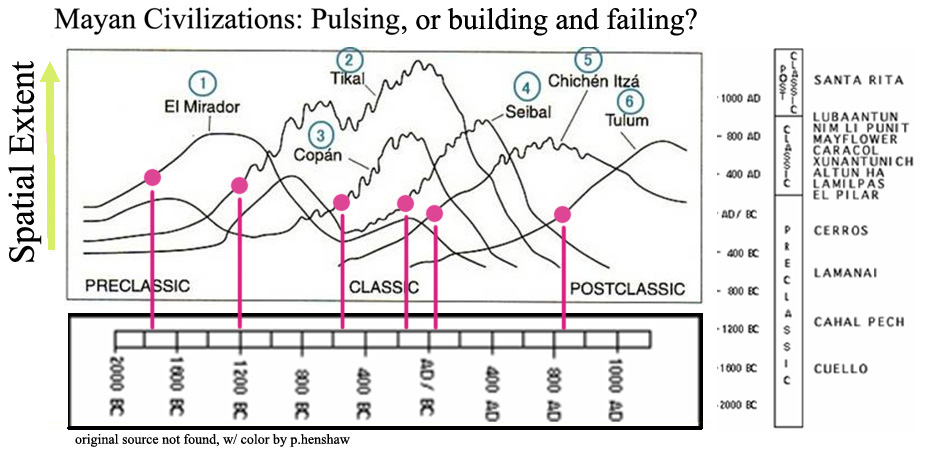
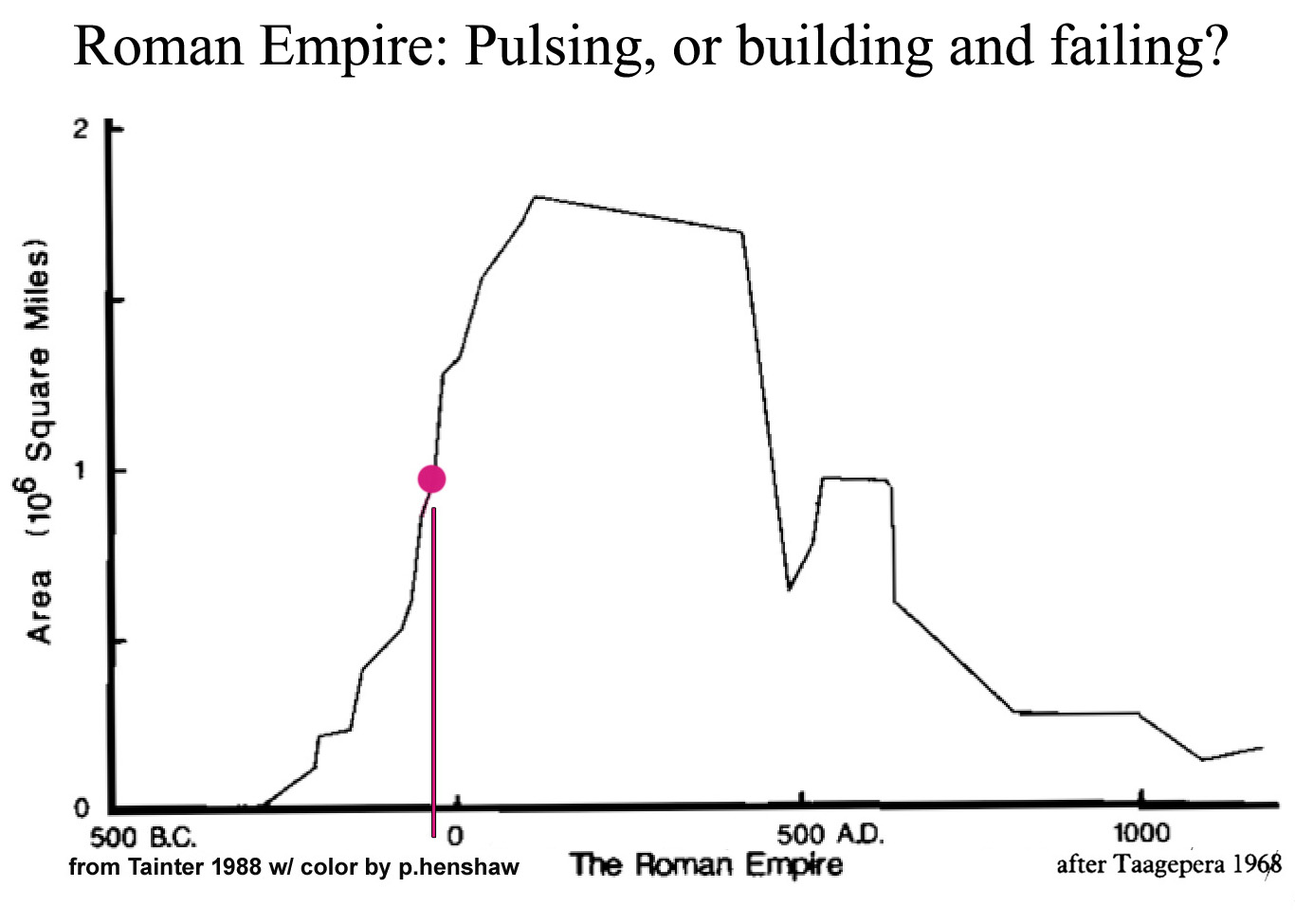
That nature is full of long lasting civilizations, that work as market organized economies of exchange, is one of the counter examples, of course. The historical experiences of the Mayan and Roman civilizations do indeed look "pulse like" from the view of these graphs of the land area they occupied. From the look of the curves they were all little more than careless eruptions of wealth and power, that spent themselves as fast as possible. The pink markers in the figures on the time lines for each show the point in time and land area expansion where these now vanished advanced civilizations stopped expanding every more rapidly. For a growth system that marks the end of their ability to grow without limits, and so, the time of each one's apparently fateful choice to attempt to overcome their limits to continue growth rather than accommodate them and build sustainable cultures.
I know a little less about the details of what natural limits each of the Mayan civilizations might have run into. For Rome it seems fairly clearly starting to hit the limits of their great resource for expansion, running out of ever bigger lands to conquer and bring order to, that could be quickly made productive by the introduction of Roman law and management. To say it simply, the plans to keep taking over ever more of their great source of wealth came to a natural end. Seeing that they seem to have chosen to keep doing what had made their explosive growth possible. They kept taking ever more from what they conquered, in the hopes of conquering more. Continuing to escalate their demands from what became a shrinking resource that way, broke the spirit of both their home lands and all they lands they occupied.
No one seems to know, yet, where the original lands of Babel were located, though somewhere not too far from the middle of the old silk route between the Mediterranean and China seems probable. There's even a strong piece of archeology of language evidence for that (14). The common words of all the modern western language groups indicate a common language source, and no one knows whose language that common root was. For example, Germanic and Sanskrit have common sounding words for some numbers and not others. What language was the common source is the puzzle, as if there was a great complex society that vanished, but was the root of all other western cultures. It seems implied that it was located in what is now the Russian Steppes or far western China, perhaps, for it to where migrants going either south or west might have wandered from. A "multiplication of languages", as referred to in the Biblical tale, might well be thought of as natural symptom of a complex society failing due to its own excessive complexity. If problems too complex to be understood for the whole are then reduced to views of many separate cultural groups with different interests, such a society might naturally begin to linguistically start breaking apart.
: 05/30/08 08/29/08 The 'widow's cruse' is named for a biblical story about an inexhaustible cup or 'cruse', and was used by J M Keynes to illustrate a way to change the form of capitalism at its limits of growth into a sustainable system. Almost no other economist saw it that way, partly because Keynes' own ideas were still being formed when he raised the subject. As I see it, the reasons behind his observations had to do with both how to describe money as a whole system, and how such a system fits with a real world. The economists that followed focused more making a self-consistent theory, excluding the contradictions of the real world, and did not see why conditions that had not yet materialized would matter. He first introduced the phrase in his Treaties on Money (5), 1930, with the contradictory statement:
"Thus, however much of their profits entrepreneurs expend on consumption, the increment of wealth belonging to entrepreneurs remains the same as before. Thus profits, as a source of capital increment for entrepreneurs, are a widow's cruse which remains undepleted however much of them may be devoted to riotous living." A Treatise on Money (1930; CW, vol. V, 1971, 125) and discussed in Chapter 16 of The General Theory
Keynes' main innovation is his way of discussing economies money as a whole system centered on money. That new way of seeing things, along with his observation that spending your surplus could stabilize your wealth, became a focus of discussion in the community of Cambridge intellectuals struggling with it. Lots of people then and later seemed to develop lots of inconsistent interpretations. My impression is that one critical issue that got particularly confused was whether limiting investment by consumption was a way to correct for periodic business cycles, or for the ultimate end of real growth. In any case the "widow's cruse" was called 'the fallacy' by people who seemed to think it was a solution for business cycles(6). It would indeed be a 'fallacy' for that. Keynes intent to limit investment growth at the climax of capitalism was clarified in his later General Theory (7) seeing it as a voluntary choice of capitalists, saying:
"if... this more favorable possibility comes to the rescue". and “If I’m right in supposing it to be comparatively easy to make capital-goods so abundant that the marginal efficiency of capital is zero [i.e. at system ‘overshoot’], this may be the most sensible way of gradually getting rid of many of the objectionable features of capitalism. For a little reflection will show what enormous social changes would result from a gradual disappearance of a rate of return on accumulated wealth. A man would still be free to accumulate his earned income with a view to spending it at a later date. But his accumulation would not grow.”
In any event, the point appears to have been quite lost on his followers and critics alike, except the equally brilliant radical economist Kenneth Boulding. Giving up compounding earnings would have been and remains mostly unthinkable as a self-imposed act of "good will", limiting rather than promoting growth, and foregoing multiplying personal wealth just to preserve everyone's existing investments. Today, of course, we might just call it 'sustainable design'. It's a new form of "prudent man rule", to preserve capital when growing investment is running into resistance in a world of emerging conflicts. Reallocating the surpluses of any system is a very natural direct means of taking control of how they develop. Only if people perceive it as a true structural imperative for the long term stability of our whole way of life would it be even thinkable to do that with all the surpluses of capital investment the world over.
The biblical story is that God ensured that a widow's flour and oil would always be refilled however much the prophet Elijah ate of them: "For this is what the LORD, the God of Israel, says: 'The jar of flour will not be used up and the jug of oil will not run dry until the day the LORD gives rain on the land.' " (9)
Kenneth Boulding, was a noted economist and co-founder with Ludwig Bertalanffy and others of the Soc. for General Systems Research. He was also a long term advocate of the "widow's cruse" consumption approach to the climax of capital (10), having argued with his old professor Joseph Schumpeter (11) who insisted a stationary state would always reduce returns on capital and the nominal interest rate to zero. The core economic question is just that, whether at physical system climax the rate of return on investment goes to zero. What most have failed to see is that a stationary investment can result any of the three controlling variables going to zero 1) the investment capital 2) the investment returns or 3) the compounding of the returns. Were it the will of investors to use their returns for good works instead of compounding their own wealth a stationary state could be maintained with simultaneous high levels of capital and high levels of returns.
The general conservation equation for auto-catalytic growth compares the resource for making products (P) and the saving from it for developing the process (S). If the linked markets for it's "work" and "investment" grow and stabilize together, then the system stays in balance as it develops. In an economy that occurs when the returns added to savings (S*r) and spending from savings (S*s) match the increase in products (P*p).
(When physical limits cause product growth to stop, p = 0
THEN stable change over time requires:
EITHER: r = 0 and an end to average positive returns on investment
OR: r - s = 0 so the comfortable positive returns are spent on purposes other than multiplying returns
SO: both S1 = S0 + S0 (r - s) and S1/P1 = S0/P0 )
That’s Keynes “widow’s cruse” idea for turning the economies into an “inexhaustible cup” with a lasting sustainability plan, to spend enough of the seed money on something useful for the system to stabilize it. It’s not about stabilizing growth but stabilizing a healthy economy without growth, treating it as a natural living system switching to maturation, sacrificing the practice of limitless growing investment and concentrating wealth. It would be a big cultural change for us, but once it’s realized why it was always going to be physically necessary…, as at the end of growth there is no other healthy economy option … there are ways to provide quick systemic relief.
It's also an application of "new physics", using scientific models to refer to and assist in studying complex physical systems that remain undefined. That's an approach that avoids representing nature as the conceptual model used, and allows connecting different languages of interpretation through their references connecting aspects of the same physical things.
Physical systems that operate by themselves in relatively passive environments develop by auto-catalytic growth from a seed process of some kind, generally animated by their own self-organizing parts. The whole system develops by treating some of its products as operating surpluses, and using them to build the process. That multiplies its scale and the surpluses until the erupting internal and external environmental imbalances disrupt or exhaust it, or trigger a switch to maintaining the surpluses and adapting to the new environments by completing and perfecting the design its operations.
 |
:
08/29/08 The Sorcerer's Apprentice
is an ancient children's fable about a youth working as a servant
to a master sorcerer and told to carry water to fill the household tub while the
sorcerer is away. The apprentice takes the sorcerer's hat and casts a
spell having a broom carry water for him, but then goes to sleep. When he
wakes the house is overflowing with water and he is unable to reverse the spell
so he takes an axe and chops the broom to bits. Each splinter then becomes a new
water carrying broom he can't turn off. For the convenience of the story
the sorcerer returns just at the peak of the apprentice's dismay having
unleashed a hoard of all too willing 'helpers' and his complete undoing. That's our
situation too, and our 'magic broom' is still multiplying, but no 'sorcerer' is
going to return to save us. What the sorcerer symbolizes is not the
master that returns to save us from our mistakes, but the master who passes on
his power but not the wisdom to handle it. Wisdom is never passed on.
In the real experience of being left with power you can't control, the sorcerer
never returns. He's our parents or our predecessors, or the God who
gives us the breath of life but no hint of all the trouble we can inadvertently
cause. The wisdom to sense one's own limits can only be learned bye
yourself. The particular model of disaster, out of control
multiplying 'helpers', is a clear reference to the classic development dilemma
of first trying to create things to do our work and run bye themselves, the
dream of everyone, and then not knowing how to turn them off. |
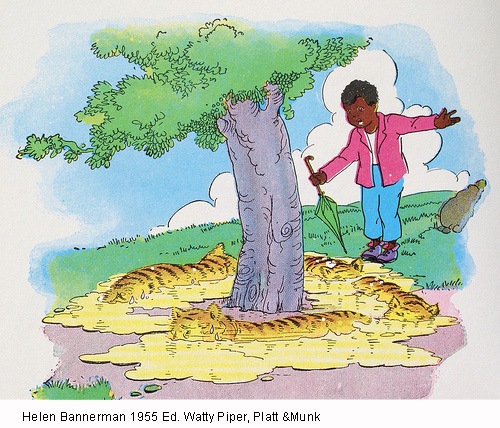 |
11/17/09
Little Black Sambo, another ancient
children's fable, deftly portrays what the innocent escape. Sambo's
problem is that in running from a tiger he becomes trapped in racing around and
around a tree, and having to run ever faster.
|
:
08/29/08 Dynamic
Models of the Choice... :  or
?
What nature does when she changes systems alters their design and makes them
work differently. Simple illustrative dynamic models of how the physical system would respond to
a) proactively "switching off" the multiplier to stabilize the economies or b)
letting it run until the economies are disabled by rising crises, is described in
an elementary way in
NatClimax.htm. It shows a simple dynamic systems model
for stabilizing the economies by switching off compounding multiplier, the primary
"forcing
function" of using success to add to success, now driving the multiplication of
global impacts on the earth faster than shared benefits. The
real economy is not a systems equation, but a complex learning process, of
course. The model offers a germ of insight to interpret in context. My approach might be called either 'Natural Systems Theory' or
'Behavioral Economics' as it has to do with understanding the developmental
learning processes of complex physical systems
*def-note.
or
?
What nature does when she changes systems alters their design and makes them
work differently. Simple illustrative dynamic models of how the physical system would respond to
a) proactively "switching off" the multiplier to stabilize the economies or b)
letting it run until the economies are disabled by rising crises, is described in
an elementary way in
NatClimax.htm. It shows a simple dynamic systems model
for stabilizing the economies by switching off compounding multiplier, the primary
"forcing
function" of using success to add to success, now driving the multiplication of
global impacts on the earth faster than shared benefits. The
real economy is not a systems equation, but a complex learning process, of
course. The model offers a germ of insight to interpret in context. My approach might be called either 'Natural Systems Theory' or
'Behavioral Economics' as it has to do with understanding the developmental
learning processes of complex physical systems
*def-note.
: 08/29/08 11/17/09Roots in Phenomenology... 40 years ago I lived with a couple guys who were working on their doctorates in phenomenology... at the New School. At the time I was sort of looking for why I was not interested in going on with physics, and they seemed to be talking about the reality of phenomena as we see them. That is probably where I got the idea of direct observation to connect the developmental processes you observe with the individual phenomena they become. "How original" you might say sarcastically... but that approach also ran into a stubborn perceptual blindness in myself and others.
A blind assumption followed in most of modern scientific theory is that the subject of science is to arrive at general explanations for our information, i.e. to invent own mental substitute for what we observe. I think the subject is not to explain. I think it's to discover, using what our explanations don't answer to help explore the realities of the world. Oddly, that leads directly to better understanding all individual events. Individual events don't follow general explanations. The difference has been highly productive.
Over the years I developed an empirical model of something that now looks a good bit like Whitehead's and Pierce's process philosophy (12), in which I need to be better versed. One of those old friends pointed out to me recently that the blind spots in observing natural system processes I had been writing about seemed to match the idea of 'functional fixedness' developed in Gestalt psychology. It matches well indeed!
Some of the specific cognitive gaps in our usual explanations match the evidence so well they appear to stem directly from the inevitable defects introduced when one system (of things, ideas or models etc.) is used to represent another, i.e. inherent in representing anything with explanation! Both physical and explanatory systems are individually organized around their own self-consistencies and developed relationships with their individual environments. So they can not represent another's in a self-consistent way. Accepting that in principle turns explanations into questions, at least the way I use it. Every explanation then needs to remain open to question, and that leads you to why. It helps me notice and appreciate what many would call "cognitive dissonance".
Dissonance is the direct experience with things that can't be made part of and consistent with one's own way of thinking. It helps point out things that are of independent design, like how we acknowledge other people as individuals partly because we could never really understand them. How we can't incorporate, or can't "make sense of" dissonant realities displays both their being necessary and disconnected, a kind of undeniable order in the world around you that is mysterious, and so evidentially existing independent from your own way of making sense of things. Distinguishing organized dissonance as different from noise is part of the trick...
Developmental processes are a rich source of these. The local development of individual things is always real and independent, evident in the continuities and full of dissonant relationships. Using the continuities (the sensible part) to locate dissonant forms emerging is just one good way to locate them and begin to explore them. That uses the emergence of conserved change, physical evidence on new flowing processes, as a clue to the presence of unobserved physical "other's" that conceal some whole system of organization and change. They may become important to the world, or not, but your clue to where and what they are is that something about them makes sense that you really can't make sense of. To me it opens a great store of good questions.
: 3/31/10 Cognitive Traps & Escapes - To do this work I needed to slip out of a great variety of cognitive traps, mostly coming from the way consciousness represents itself to us as being the world we live in. Cognitive models and physical systems are remarkably different in design and behavior, but our emotionally linked mental models are amazingly convincing none the less, and we evolved to have them be so it appears. The problem is partly how our simple reasoning of things misses a lot of how things in nature actually work. The bigger trouble develops when our mental shortcuts and the complex environments of physical realities we are part of, change their behaviors independently. My website is an archive of experimental methods for learning to trace the developmental processes of natural system change.
Research Essays on how theory can recognize and respond to change in the world beyond it:
Some of the relevant short pages are:
References:
1) Angus Maddison. 2001 The World Economy; Vol 2 Historical Statistics. OECD
2) J. A. Tainter 1987 The Collapse of Complex Societies. Cambridge
3) Walter Lipman. 1922 Public Opinion. NuVision 2007
4) Plato. Republic; Book V. 473. Jowett transl.
5) J. M. Keynes. 1930. Treatise on Money.
6) Robert Skidelsky.1994. John Maynard Keynes, The Economist As Savior, 1920-1937. The Penguin Press. p 447-448
and - David Laidler 1999 Fabricating the Keynesian revolution: studies of the inter-war literature, Cambridge Press. p 133
7) J. M. Keynes.1935 General Theory of Employment Interest and Money. Ch16 Harcort Brace 1964; online w/ notes http://www.synapse9.com/ref/Keynes-ebook-TheGeneralTheoryCh16notes.pdf excerpt from Project Gutenberg of Australia ebook
8) King James Bible. Genesis
9) King James Bible. I Kings 17:8–16
10) Kenneth Boulding. 1950 Reconstruction of Economics. New York: Wiley
11) Kenneth Boulding. 1981 correspondence
12) Process Philosophy - as at en.wikipedia.org/ Process_metaphysics, Philosophy_of_Organism, Process_(philosophy)
13) H. T. Odum - 2007 Environment, power, and society for the twenty-first century: the hierarchy
14) Colin Renfrew 1987 Archeology & Language, The puzzle of Indo-European origins
Sustainability
Science & Consulting - Physics of Happening
-
Concept & Comment

 The story is is
remarkably close to our experience, of being caught in an escalating "rat race",
having to chase something that threatens to eat us. Metaphorically
the rat race is tricked into chasing its own tail, like our Ponzi schemes, and
magically turns into butter for our morning pancakes. We only need
to step out of the circle. That's the trick, and the real world
version does have a large "peace bonus" for ending the chase, that we might
celebrate, but do need to use wisely!
The story is is
remarkably close to our experience, of being caught in an escalating "rat race",
having to chase something that threatens to eat us. Metaphorically
the rat race is tricked into chasing its own tail, like our Ponzi schemes, and
magically turns into butter for our morning pancakes. We only need
to step out of the circle. That's the trick, and the real world
version does have a large "peace bonus" for ending the chase, that we might
celebrate, but do need to use wisely!