A simple model
of Keynes' Proposal for stable Economic Climax
Naturally
Stabilizing Economies by Ending
Compound Investment (for profitability)
JL Henshaw
id at synapse9.com
09/16/07 05/21/08 08/26/08 6/19/12 2/26/14
The graphs are of a very simple but very natural economic
"through-put" model from an Excel spreadsheet,
using the variables: Investment, Capital, Products and Returns on Investment,
emulating Keynes' "widow's cruse" solution:
1) Investment funds build Capital goods
2) Capital goods build Products
3) Capital
goods and Products
both decay over time
4) Investment
funds produce Returns (R) and do not decay
5) Returns (r)
are added to Investment
funds at first
6) So Investments, Capital
and Products at first multiply,
7) and then total Capital either starts to decay or
starts to stabilize.
The model and definitions of the variables are to be
found in
GrowthSwitch.xls. It's a series of 3 simultaneous relationships, Economic
Product: P1=C0*R, Capital: C1=C0-C0*d+I0
and Investment: I1=I0+I0*r. Stage
A is a period of steady exponential growth, with r=a Stage 2 makes I0=0 at step 20, and
Stage 3 makes r=0 at
step 20. That's the entire difference. Many more features
could be added, but the result is the same if, as here, 'r' includes all
the regularly reinvested returns on investment and setting it to zero has no
other effect on how returns on investment are used.
Years in the model correspond somewhat to decades
in the real history of modern industrial age economic growth. Stage A in
the model shows 20 periods of "normal growth" following the nominal "growth
constant" observed for the past ~200 years. Then, to keep the model very
simple and emulate actual investor options, Stages B & C then show either
investors choosing to hord their wealth to "protect" it from ever increasing
risks of failure, letting the economy decay, or stopping their compounding of the returns
so growth then coasts to a stable climax. These
demonstrate the control potential for these two types of 'intervention', one
destructive and the other constructive.
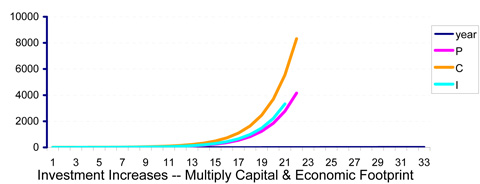 |
Stage
A. In limitless economic growth, investment builds capital goods, and
capital goods build products. Returns of a small %
then adds to investment, and this forms a continually multiplying spiral of
expansion as long as resources of ever greater amounts and ever lower costs keep
being found too. |
| |
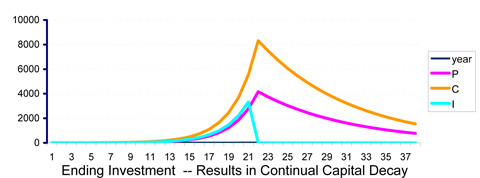 |
alt Stage
B1-(decay). If investment were suddenly ended, capital goods would decay with some
parts wasting away more quickly than others, and everything would wind down.
It's hard to imagine a choice people could make to end investment permanently.
It's easier to imagine how a gereral financial collapse might result in economic
breakdown and decay. The reality is that most complex societies in
history seem to have done something of the sort, and vanished without
leaving a record what the self-created problem they faced was, like
Rome, the Mayans, Easter Islanders. |
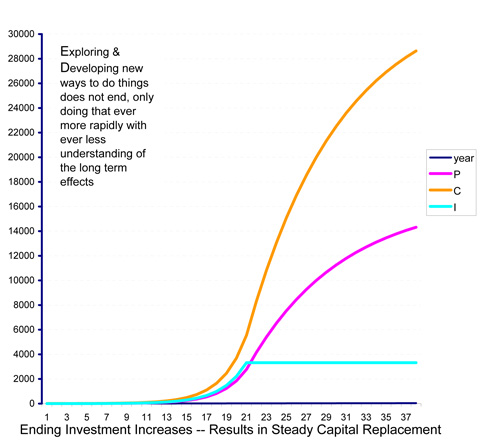 |
alt Stage B2-(climax).
Ending the compounding of investment would be an actually quite small
change in the economy, having a quite large accumulative effect. Here only the increment
by which investment is increased each year is restricted. The
behavior switches from a run-away explosion to
seeking a self-defined natural balance.
This represents transformative cybernetic control. It is a large
conceptual leap to imagine, but satisfies the necessity that we somehow end our
exploding economic footprint on the earth. It does so without disrupting
the physical economy of the time except to alter its rate of change.
What most people don't realize is that this is the growth sequence of their own
original biological growth and development. We all started from a short
period of exponential expansion (starting from a single fertilized cell).
That 'immature' explosive growth was followed by switching to maturation and
leading to our independence in the world. Maturation is the step to
independence. That's actually the normal development sequence for
all living things, and an option that is available for economies. If you
consider the time scale in the charts to be hundreds of years, give or take,
this might also suggest the general time scale over which this kind of change
might take effect, starting growth for a short period and maturing growth for a
long period. |
Discussion
More on the theory of self-organizing climax as a
solution to the modern crisis, from a
natural systems perspective, is at Natural Climax
and
found
searching my site and my blog for mentions of Keynes and elsewhere in
my Journal & intro to
my general scientific method.
This elemental spreadsheet model illustrated by the
graphs above shows the natural effect of a self-organizing system first building
itself up with compound self-investment, then using its profits to care for
itself and its environment so its investments can continue being profitable.
At that turning point where increased investment begins to drain the resilience
and resources of the system, the automatic compounding of investment earnings
for further expansion ends, to then be used to maintain the system as it's peak
sustainable level of profitability and creative vitality, like organisms do as
they mature.
Real sustainable development is more complicated, but as a
financial choice it is comparable to a single simple policy decision, to preserve
capital by turning off the "multiplier". Otherwise the multiplier is only
turned off when investments or returns themselves decay or collapse. The
general idea was first suggested by economist J. M. Keynes in the form of the
Biblical parable of "the widow's cruse" about
Elijah coming to stay at the home of an old widow, and being granted an
inexhaustible bowl of flower and cup (cruse) of oil. The financial
community in the 1920's noticed that it would not stabilize ever faster growing
money like Keynes' other proposals, but would end it. So they called the
option "the fallacy". Keynes then discussed the the same general
idea in only very general terms in speculating on the future of capitalism in
his main 1935 book ,"The General Theory of Employment Interest and Money", saying, :
"may
be the most sensible way of gradually getting rid of many of the objectionable
features of capitalism" (General Theory, Ch 16)
It was then promoted for decades by visionary economist Kenneth Boulding,
which I discovered it in the early 1980's when in speaking with Ken about my work on
the same principle from another direction .
This version focuses on the simplest rule that would end the
compounding of returns, voluntary spending by investment owners.
To have investment, in aggregate, only expand from the savings of earned income,
instead of by the compounding of so called "unearned income" would both keep economies
from destroying their investment futures, and also from falling into either
local or global credit traps, as have been so prevalent
in the long history of financial panics. To keep economies
profitable in the long term investors would need to spend their profits wisely,
on their own true interests, which would then maximize the profitability of the environment they are
profiting
from, i.e. maintaining wealth as an endowment for sustainability.
---
The short statement:
Economies grow because surpluses are reserved for expanding them.
Growth in a market economy is managed by allocating funds from a savings pool to
generate returns, and
those returns then being used to add to the pool and increase the total, growth.
Investment earnings are called "unearned" because the real earnings come
from the creativity of the businesses, markets and society invested in, not
the investor, and would then come with a natural "fiduciary duty" to use the
proceeds in the interests of the source of the creative communities that
actually generated them.
What science can say is not how to use them, but to
observe that when the creative society is not yet confronting limits, that
compounding investment increases total investments and unearned income returns exponentially, by adding positive
%'s of the prior total. The end for that comes at a point of
"over-investment" when increasing investment becomes less and less
profitable for the whole by straining resources and resilience while
producing growing inequities conflicts rather than general vitality. Then, as the whole
fails to prosper, investors still
seeking maximum growth for themselves do so as the expense of everyone else,
rather than as before to the benefit of everyone else as well.
Seeing diminishing returns for the whole approaching, a choice
could be made to
prevent a terminal decline in the profitability of the whole, by a collective
choice to end the general compounding of returns, enforced purely by that
abuse of the wealth of all being socially discredited.
One practical guide would be to distinguish between earned and unearned income,
encouraging people to save from earned income, but not to save
returns on investment (unearned income). Then investors would need to
spend their unearned income on purposes serving other values.
The actual accounting rules would be more complex, probably allowing
compounding for returns invested in important public purposes, for example,
and perhaps accumulatively up to 100% of anyone's own earned income.
It's
not important here to discuss all the reasons our
economy developed a plan to grow ever faster forever. It's only
important to note that literally all kinds of systems in nature initially
develop with a burst of explosive growth of this kind, however it natural begins or
will end.
It's essentially a law of physics, that nothing can start at it's full size, and
that
due to the conservation of energy can only begin with a series of stages of this
kind of non-linear
development we call 'growth'.
No
doubt ending economic growth would be a big adjustment for the world economy
with so many institutions designed around perpetuating it forever.
Ending growth would not mean mean slowing
anything down, except acceleration of speeding things up! It only necessarily
means stabilizing the scale of the economy, and its rate of constant
self-replacement with new things, not ending it. Stabilizing the
rate ongoing change to keep it from accelerating ever faster, and averting a
LONG list of hazards that would otherwise naturally leads to. So
it's assures a more profitable way to go. It just means removing a steering principle
for ever more unmanageable change, at the limits, to one for guiding investors to
invest so the system as a whole remains as profitable and creatively changing as
can be.
Nature demonstrates this
investment strategy at the point where
organisms or other systems begin to mature, as athletes reach their peak ability
to perform at their limits, not when they are immature and improving rapidly.
It's a time when accumulative
self-investment stabilizes, at a peak of vitality, and increasing ability to interact with their environment. It's a process of
turning from inward to outward interests, like students perfecting their
development as they become independent actors in the
world.
It's the standard investment principle of
family businesses, following the stages of intense work and sacrifice to build a
business, to the point they can see it succeeding for their true interests, to
then turn their attentions and earnings to those interests instead, making their
home comfortable, providing for their children, contribution to their
communities, what growth is really for.
___________
jlh