•  
  • What to do (27)

Questions from Bill Rees & response

by mothernature Published on: May 13, 2012
Comments: No Comments
Tags: No Tags
Categories:Natural Economy, Natural systems, Transformation, What to do

Bill Rees asked some excellent questions about my submission to the Long Term Capitalism Challenge to use natural principles for managing growth to sustain the profitability of our economic system.    I think I made good responses too.

_________

Hi Jessie -

Thanks for the opportunity to review your proposal.

I agree with your diagnosis of our economic malady but admit to struggling a bit with the remedy. Let me start with this sentence:

“When people spend their financial profits on good works it also [reduces the growth of money], with the added advantage when spent as for endowments instead of to compound profits, of doing a lot of good.”

Now, at the limits to material growth, the goal of policy should be to reduce the throughput of energy and materials to biophysically sustainable limits. So the above passage raises two questions.  First, what do you mean by ‘good works’?  and second, would the redirection of profits from investment in productive capital to ‘good works’ reduce total throughput?

/When financial earnings are not compounded to multiply investment, and the returns are not added to savings,  it stops the automatic compound growth of investments.    I’m using “investment” more broadly than usual, to make my statements inclusive, to include all ways in which money is spent with the intent of having it return profits.  I then break spending and investing in components if I want to study the details, using a “figure 8” model.  That’s a way to construct a global model of how income is allocated and returned as income, as a closed system with regulated money supply (Concept$).

/So, “spending” then means the opposite of investment, as money spent without an expectation of return, i.e. final consumption.  Then  “good works” most generally means final consumption used to maintain the profitability of the economy, as a universal good and necessity for survival.  One thing that economists would recommend, it think, if the added spending seemed to increase aggregate demand, is to make sure enough of it was used for non-consumption expenses like to retire debt.   The intent is to have investors treat their financial investments as endowments, and think of themselves as fiduciaries for the earth in general, to keep it profitable and using their money as the world is best served.

/Spending financial returns would reduce total throughput if it kept the funds available for expanding production systems from growing.   How the restraining aggregate savings would affect the movement of funds between ‘producing’ and ‘non-producing’ investments I have not really thought through.   One part seems to be that businesses would need to give their profits to their shareholders, to be spent, rather than to use them to grow while the whole economy is trying not to.

default
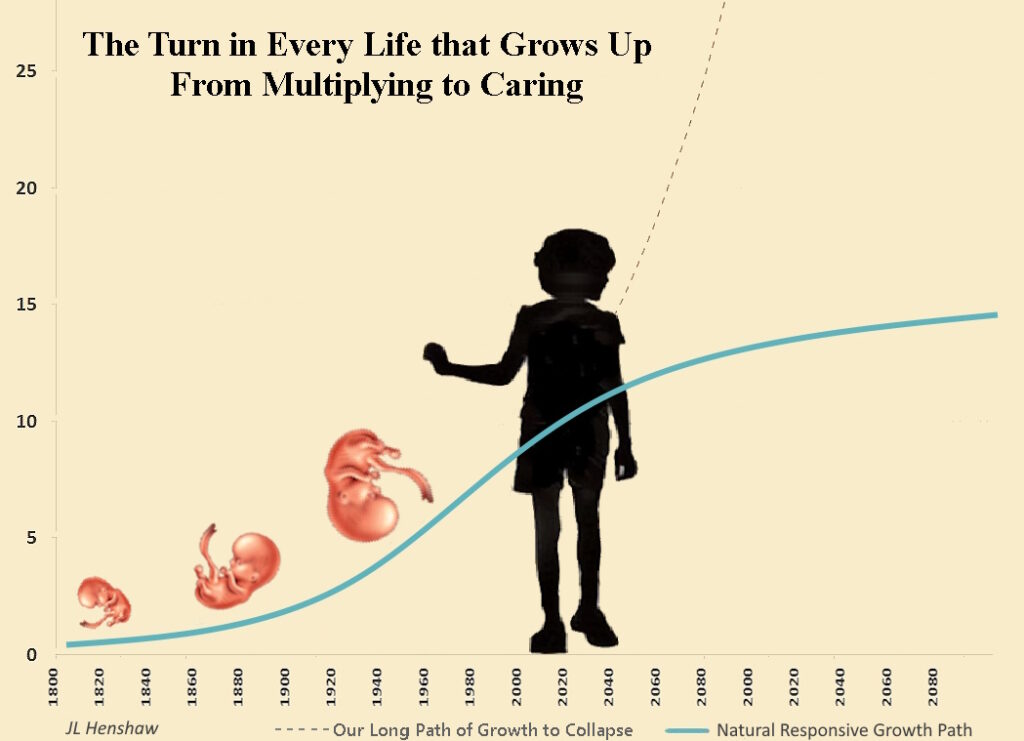
Our current growth course, growing resource depletion

(more…)

Adopt natural system principles to keep economies profitable at their limits

by mothernature Published on: May 10, 2012
Comments: No Comments
Tags: No Tags
Categories:Mail & Comment, Natural Economy, Natural systems, Transformation, What to do

The collection of “Hacks” for the Long Term Capitalism Challenge offered byHarvard Business Review, McKinsey and MIX, for the M-Prize for Management Innovation now has this proposal from me… Please leave comments on my on the MIX site (here too is fine of course).

It’s a nice new version of the long series of proposals for using natural economies as models for better ways to organize ours, a kind of systems biomimicry.

notes

  1. 1. I got some very good questions on the practical details it from Bill Rees, and posted them and my responses as Questions from Bill Rees & response, that may be a big help for people wanting to understand it clearly. 5/12/12
  2. 2. A simplified intro to Synapse9 and Natural Systems Thinking, 5/14/12

_______


The Summary

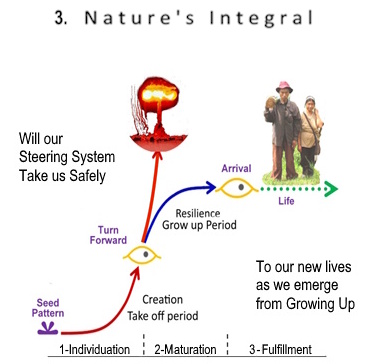
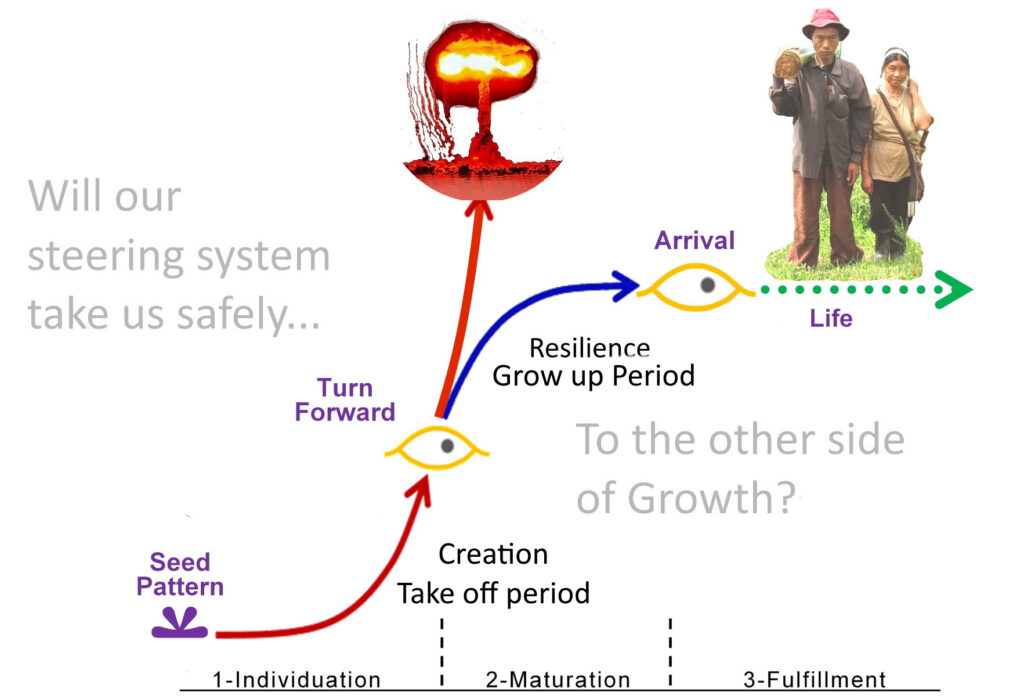
A good goal for growth would be to end at a stable peak of vitality providing a sound capital endowment for life on earth.  That would be better than ending at a peak of exhaustion, like other “tower of Babel” societies of the past such as Rome and the Mayans.

It can also be thought of as a change of “ism’s”.

It would also represent a change in form for our economic system, while still being the very same economy with the same people and rights, and reliance on creative innovation funded by investors.   By giving profits an end purpose, of caring for things rather than just for multiplying profits, it woud give the whole economy a very different purpose.    So, it can also be thought of as a change of “ism’s”.

It’s to change the use of our ability to control things, to care for them.   So we’d need to change our systematic habit of using the profits from controlling things to multiply our control, to instead care for them.   Choosing to not make the change would turn us into one of those societies of good people that work together for truly evil purposes, that no individual would want to have anything to do with.

or similarly, it seems… it’s time to grow up!     ;-)

(more…)

Resilience… for the most wrong things

by mothernature Published on: April 2, 2012
Comments: No Comments
Tags: No Tags
Categories:Mail & Comment, What to do

John Fullerton in “The Double-Edged Sword of Resilience” on the Capital Institute blog, reported on separate research by Bill Rees and Donella Meadows, on immune resistant disease as examples of how resilience can be a mortal threat.  My comment was:

__________

These are good examples, but they aren’t the ones that first popped into mind.  The post didn’t mention some of the more obvious direct threats of that kind to modern society and the earth, the great resilience of humanity’s worst bad habits.

Some are as bad, and take as much effort to maintain, as a virulent addiction to pain killers, even masquerading behind the very best of intentions.  Those may be the most dangerous cases, where people are actively protecting the resilience of completely the wrong things.

Addiction – one of many kinds of misplaced resillience (more…)

Prick or Bleed, drain the bubble or burst?

by mothernature Published on: November 25, 2011
Comments: No Comments
Tags: No Tags
Categories:Natural Economy, What to do

The problem is not exactly with the banks.

It has to do with society asking the banks to permanently stabilize a system for multiplying financial returns.

So when the economy can’t generate growing earnings the banks multiply its debt instead, creating “a debt bubble” and promises that won’t be fulfilled.   The promises that won’t be fulfilled grow without limit until there’s a collapse of confidence (‘pricking the bubble’), unless 1) the economy finds totally new ways to expand ever more rapidly, 2) a “Jubilee” is declared to write down the debt, or 3) investors start spending their profits to create earnings rather than lending them to create debt (‘bleeding the bubble’) to relieve the pressure so the economy can return to health.

The Jubilee idea, to write down all the debt (something like a global bankruptcy) is much more disruptive than needed, and is just a temporary fix.  How natural economies solve the same problem, so they can smoothly pause their growth when needed, will also cure the problem for all time and give us a healthy free market economy in the end.

……

I responded to Joachim Sturmberg on the NECSI Linkedin Forum regarding  The Eurozone as a complex network: New analysis shows connectivity as a problem and a solution.

JS 11/20/11 - All of this is really interesting.  However, isn’t there another fundamental point being lost, the core attractor of the whole system? It is all well and true to understand the interconnectedness, if the core aim of the game is all about making ever more money by whatever means, the system network will exactly do that. It may be dumb to have an exponential growth attractor, but if you have one a necessary outcome of the workings of systems is unsustainable exponential growth with all its consequences. 11/20/1

The solution is a change of attractor, and “common sense” would suggest that sustainable economic development would be a better attractor than greed – thinks a non-economist.

Let the bubble inflate till something pricks it, or relieve the pressure??

PH 11/20/11 - Well, yes of course.  That’s why I termed my first paper on the subject “The Infinite Society, growth induced collapse”.   I don’t think that’s an “attractor” you’re talking about though, but a “procedure”.  Procedures can be changed. Keynes and Boulding also came to the same conclusion, that at the limits of productive investment it was necessary to have investors stop adding as much of their earnings to their savings, to spend more of them instead. (more…)

As Physical Growth Slows, Finance Demands Don’t

by mothernature Published on: October 26, 2011
Comments: 2 Comments
Tags: No Tags
Categories:Natural Economy, Natural systems, What to do

The elementary problem of our economic system’s design

The problem arises because finance operates by a cultural belief system of multiplying forever,…  That once seemed to be how the physical economy worked.   Now it’s become obvious to most people that it was an illusion and never corresponded to the physical reality, and doesn’t allow the real economy to operate with its real resouces.

In a way it’s a very natural confusion, because people for thousands of years have thought of nature as their cultural belief system, run by Gods, theories of the future being like the past, or “Urban myths”, whatever.     It’s an “easy” way to look at a natural world, that has too many independently working parts to quite fathom.  So in our minds we get in the habit of substituting an imaginary world that pleases us… and confuse the world we invent that “we see” for the world we don’t invent that “we’re looking at”.

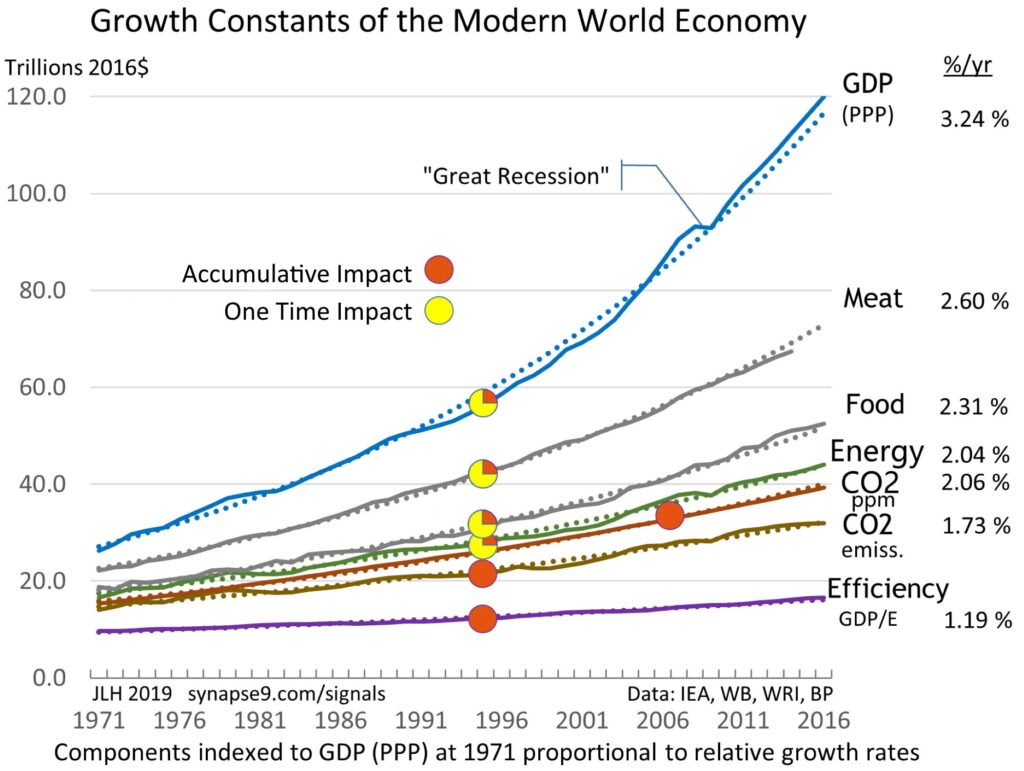
The simplest idea of what needs to change is to stop finance from continuing to grow its claims on the resources of the physical world economy.   The real economy has already begun to converge toward the natural limits that will allow it to continue.  Conceptually the task is:

– now that we’ve hit the tree, first take our foot off the gas —

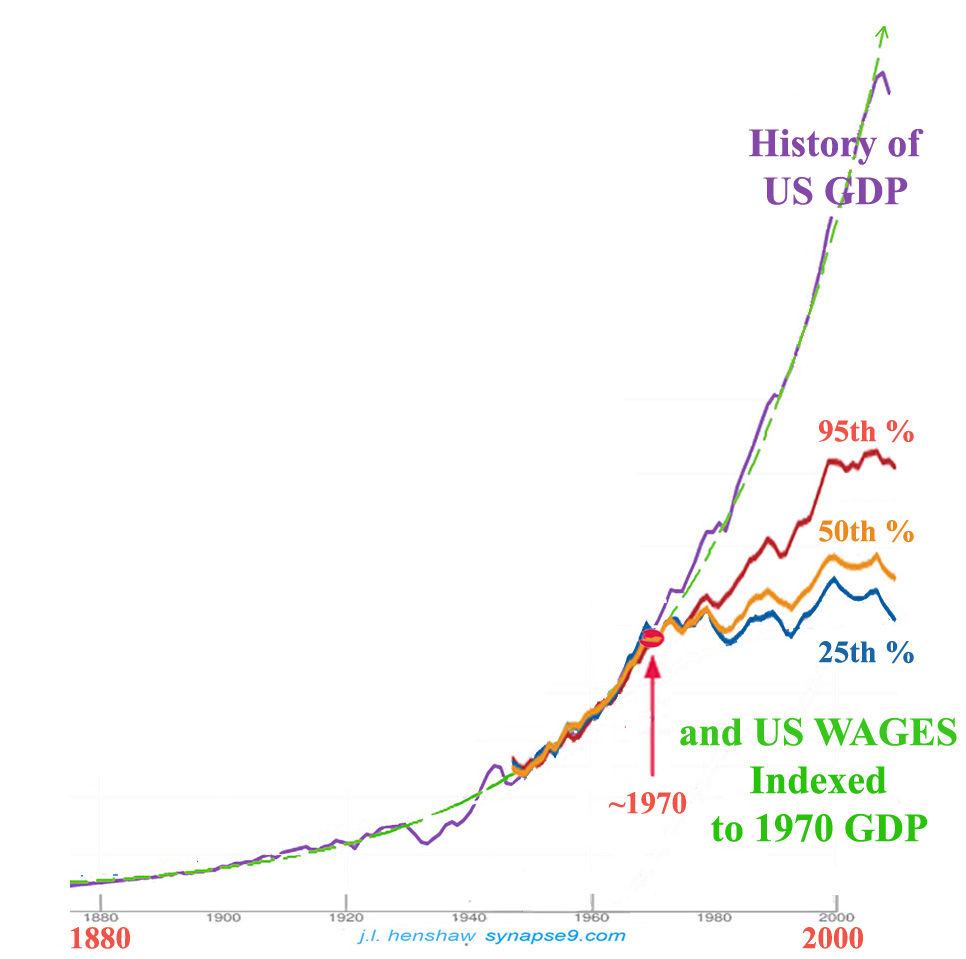
That means that investing needs to change purposes, to stop being for multiplying investment, to being for the purpose of having money to spend.    Spending from savings reduces financial capital.  The right amount of spending from keeps the demands of finance on the economy and the earth at a stable sustainable level.  At least, finance needs to restrain its demands on the economy to match how the economy is naturally responding to its limits.   It might mean finance has to “give back” half or more of the economy’s wealth.

Otherwise the resources the physical system functionally needs to operate will continue to be increasingly claimed to serve the continual growth of finance, undermining the physical system.

Physical growth slows, Debt doesn't

Can we shut down the system for repairs?

by mothernature Published on: September 18, 2011
Comments: No Comments
Tags: No Tags
Categories:among best, Natural Economy, Natural systems, Popular, Scientific theory, What to do

My response to George Mobus’ last reply to me, got a little long, so I only posted the first few paragraphs as a comment on his discussion of “The Goal – Episode I: The Basic Requirements”
++++++++++

Can we shut down the system for repairs?

The first learning steps beyond the impasse, on a new path.

Well, shutting down the world for repairs would be conceptually neat, but does not seem to use the path finding mechanisms that nature typically uses.   She offers myriad examples of how run-away growth systems can change by maturing to become stable self-managing ecologies.  That’s what we need to do, and learn how to mimic, that our culture knows little about, importantly because science has avoided studying the opportunistic learning of natural systems all but entirely.

I know this approach is problematic for someone accustomed to representing systems with equations.    Real ecosystems are niche making learning and development processes, though, largely involved in “rule making” not “rule following” .    The far better conceptual models for them are of collective learning and environmental development.   Collective learning and development systems can cling to one systematic behavior while it is useful, and the break from it to find and cling to another model, when that is opportune, because the parts are actively learning as they go. (more…)

The economic “crazies” all around

by mothernature Published on: August 15, 2011
Comments: No Comments
Tags: No Tags
Categories:Mail & Comment, What to do

the alternative journal Yes! published “Building a Resilient Economy“, a fairly well informed discussion of alternative economic approaches… except for being just like “business as usual” in one critical regard.

It's that false promise we love too much

The economic “crazies” all around..    comment by Phil Henshaw Aug 15, 2011

Of course the most glaring group of “economic crazies” are the business as usual crowd, but I’ve also looked equally closely at the alternative economics literature. There’s no question but that the alternative schemes are differently crazy, but just as unworkable in a physical world as BAU.

(more…)

It’s the leeches that make us strong!!

by mothernature Published on: August 5, 2011
Comments: No Comments
Tags: No Tags
Categories:Mail & Comment, Natural Economy, Popular, What to do

I say it in that ironic way to emphasize the changing role of putting money into the economy to take more out.   It does make the economy grow stronger at first.   Standing outside the struggle of its creative struggle, letting your idle money milk it for more money, first has a stimulus effect on growth, but in real terms is always being being a leech on the system too.

While the system is discovering ever more opportunity to expand the more it expands, then “being a leech” at first does indeed make it bigger and stronger.   That corresponded to the period roughly from 1600 to 1950.

From then on it has successively weakened and foreshortened the future for economic system as a whole.    It’s the continuing use of money to demand ever growing earnings from one’s idle savings from the past, past the point in time when it starts accelerating the depletion of economic resources and opportunity, is the

“Mr Hyde” that automatically follows the “Dr Jekyll”

of magic productivity that being a financial leech begins with.

(more…)

2nd Global Heart Attack, …lifestyle change needed

by mothernature Published on: August 5, 2011
Comments: No Comments
Tags: No Tags
Categories:For teachers, Mail & Comment, Natural Economy, Natural systems, What to do

We’re driving an underperforming asset to return ever more

Excessive demands on ANY relationship naturally produce systemic collapses, like we’re now experiencing.   I’ve been pointing to the root causes, in considerable detail, for many years.  Ignoring them hasn’t made them go away.

It’s like compelling a runner to run faster when their body needs a rest.  At natural limits you need to pace yourself, in response to the responses of the world around you.

It’s hard to grasp how we could have developed a world of expert designed systems that ignore that most obvious principle of survival, but it never the less is clearly evident. Our cultural belief is that driving the economy to produce multiplying returns is the ideal of economic stability.

Pushing too hard naturally leads to collapse

(more…)

Return to a world that works? Learn to steer!

by mothernature Published on: August 2, 2011
Comments: No Comments
Tags: No Tags
Categories:For teachers, Natural Economy, What to do

Jay Hanson’s post to EconCritique@yahoogroups.com that “Economics is rotten at the center: The “Math/Logic Paradigm.” was passed on to me.   He basically found that economics is a social construct, of ideals that can’t be discovered in nature, and prompted this [edited] reply.

Jay,   I like how you aim at finding the conceptual errors.   It’s a good clue that problematic assumptions are neither possible to prove or disprove, suggesting they are just social constructs or definitions, rather than principles of nature discovered by observation.

A still greater fault may be found in our expectation that the world follows our abstract models at all.  That nature would follow our social ideals itself seems to be a pure social construct unsupported by observation.   Our beliefs we construct of our own abstract ideals are quite unable to articulate many features of how the systems of nature work, so it’s a mystery we haven’t acknowledged it.

The art of steering, timing the world for the moment to act

(more…)

page 1 of 3»
Recent Post Dates
May 2012
M T W T F S S
« Apr    
 123456
78910111213
14151617181920
21222324252627
28293031  

Welcome , today is Monday, May 21, 2012