and for the use of one’s podium
| Jessie Lydia Henshaw Please quote with credit and a link to this page CC BY-NC-ND Creative Commons license 4.0 |
Below are three short pieces
I. WHAT WE TOTALLY MISSED
II. THE SYSTEMS THINKING WE ALREADY KNOW
III. THE MEANING OF OUR OLDEST DREAM
They’re to help our enormous audience with the great puzzle of what to do now, now that we’re at the very ends of the earth. We have no more excuses for continuing to use up all our options to make our home a good place to live. The wrong turns we’ve made go back a very long way; with most of our history and brilliantly thinking animals, we did not live in civilizations growing to their famous collapses. So we have some original good senses to build on that we can still recover, much of it recorded in plain sight by the richly meaningful words we made that connect our minds to nature. That language has been harmed and distorted by our falling into traps, requiring us to endlessly multiply our power over nature, each other, and ourselves, a question of steering.
I. WHAT WE TOTALLY MISSED – The current decade of growing breakdown and dysfunction in critical natural and societal systems needed for good lives, even in language itself, and the environmental, climate, inter-cultural, international, government, and economic systems didn’t develop overnight. The interventions of scientists of many kinds, and perhaps most notably the economist J. M. Keynes, have long pointed to the whole system instabilities that would develop as a result of continual doubling of our impacts on the earth and each other, driven by profiting from compound investment, have been oddly very clear and ignored for a long time.
Despite great efforts to avert the whole system crisis now upon us, its disasters have also continued to spread and escalate, the harsh realities finally becoming quite undeniable. Why don’t we do what we do best, though, see what’s amiss as things to do and get about doing them? Is it that we’ve given up trying to manage the unmanageable, or just not noticed we’re using outmoded management for a very natural kind of whole system crisis for an endlessly multiplying system? What if we changed the story? What if we saw what’s wrong as the perverse consequence of the economy’s “growth imperative” cheating us out of every innovative solution we’ve tried?
Shouldn’t we have foreseen that the growth economy would use innovations to heal the huge damage growth has caused, now seen so clearly in hindsight? What seems to have happened is that those caregiving efforts were exploited as efficiencies to invest in, speeding the profit growth as the disruptive innovations disrupted the environments, economy, and lives of others. Honestly, of course, such a dramatic change in reality was probably not expected by the investors blindly investing in making money as the cost/benefit curve turned upside down.
That’s what the data seems to show so clearly if just looked at with an open mind. Because of that, we do need a “general law of care” for the people who didn’t see what was coming to help us all learn what happens when long-trusted rules turn upside down. Nature’s growth rules always reverse as systems approach their limits to growth. See if you can think of one that doesn’t. In personal relations, what’s on the other side of affection as it’s pushed too far? What’s the better growth policy for a business? Invest in what was profitable before till you go bankrupt, or treat growth as fragile and care about serving the whole world you live in?
So, the environmental and sustainability movements need to be forgiven and forgive themselves for not realizing that cause and effect would reverse as we began to see growth becoming the most destructive rather than most creative force on earth. Who would have ever guessed that the growth economy would misuse 50 years of dedicated effort and creative collaboration for the opposite purpose? Nobody at all would have, well, except a few like Keynes, who studied the ironies and looked around the corners of the systems we energize.
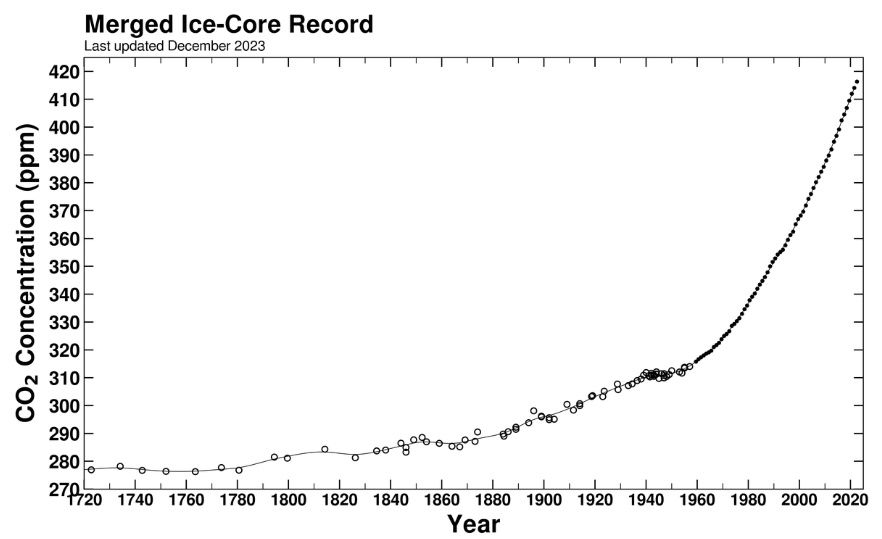
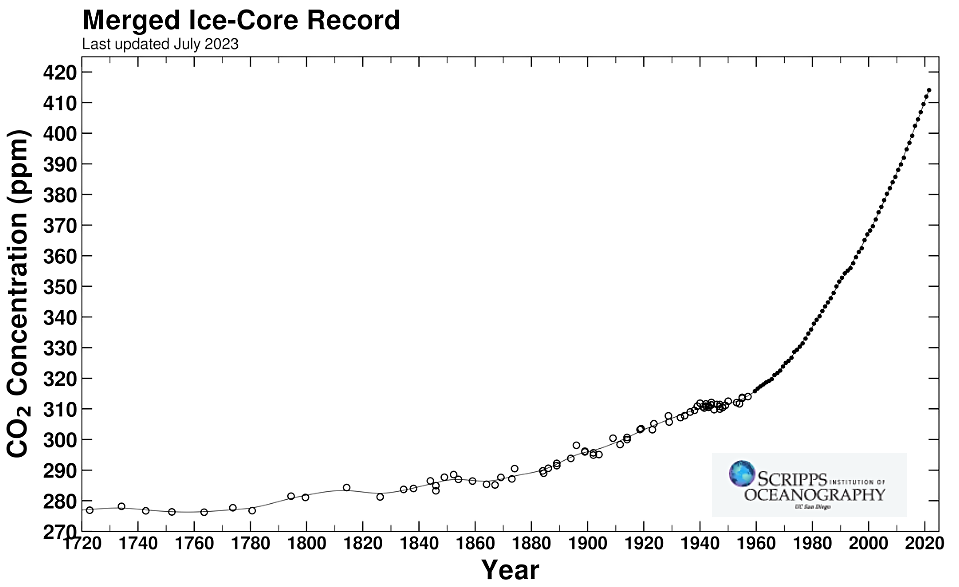
Sustainability became a growth stimulus and is one of the oddities, making things popular, efficient, and easy to multiply, with great social support. So, those efforts both failed on the one hand despite the dedicated efforts and also backfired, profiting the dumb system that didn’t know when to quit for threatening its existence, too. You can see that plain as day in the CO2 curve below, not a ripple of hesitation in the CO2 growth curve, just as if *everyone* was strongly in favor of it.
So, it seems to be time to look at the whole problem from a fresh point of view and start sorting our choices.
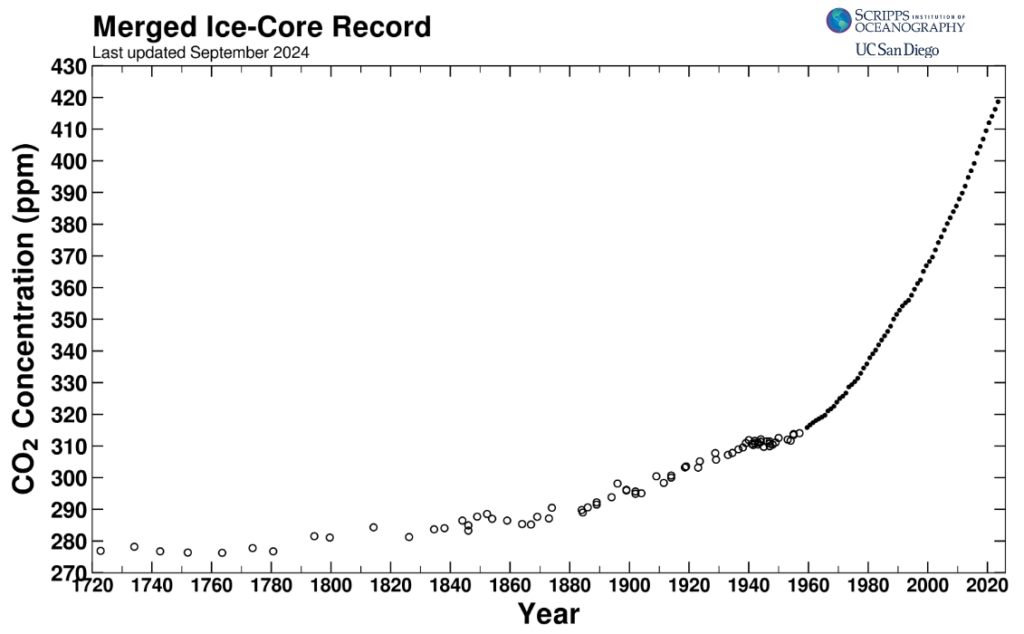
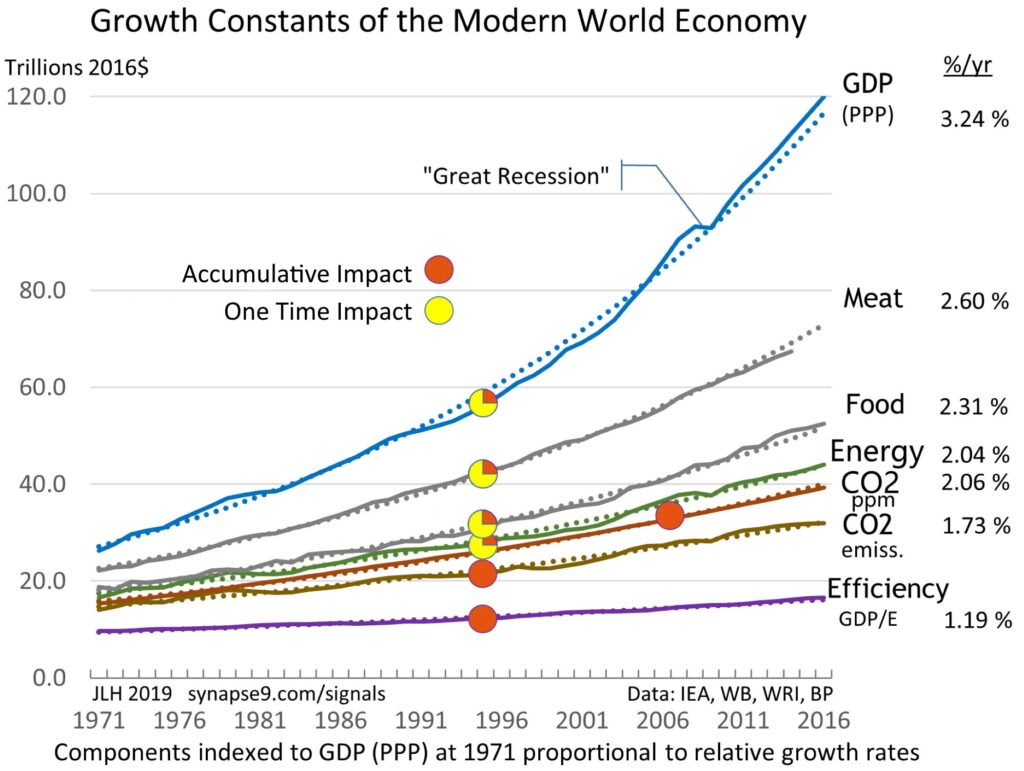
- The current world measure of atmospheric CO2 (the main source of the exponential climate heating crossing the thresholds of lasting harm we’re now experiencing). – The trend is closely proportional to world GDP growth from 1971 to the present (7), with CO2 growing at ~2% a year since WWII and GDP at ~3.5% a year.
– CO2 Data – Scripps: https://scrippsco2.ucsd.edu/data/atmospheric_co2/icecore_merged_products.html
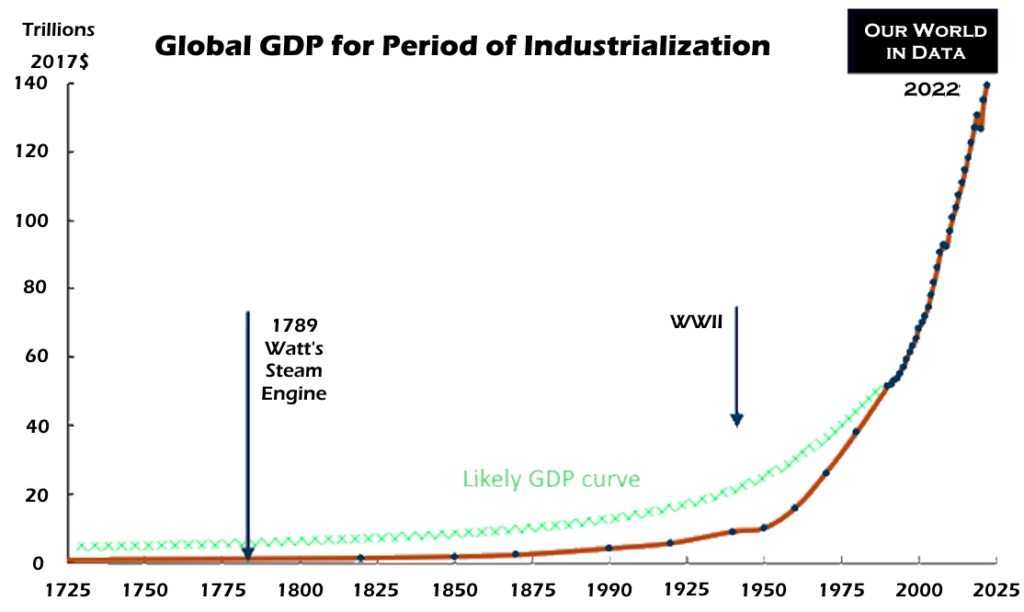
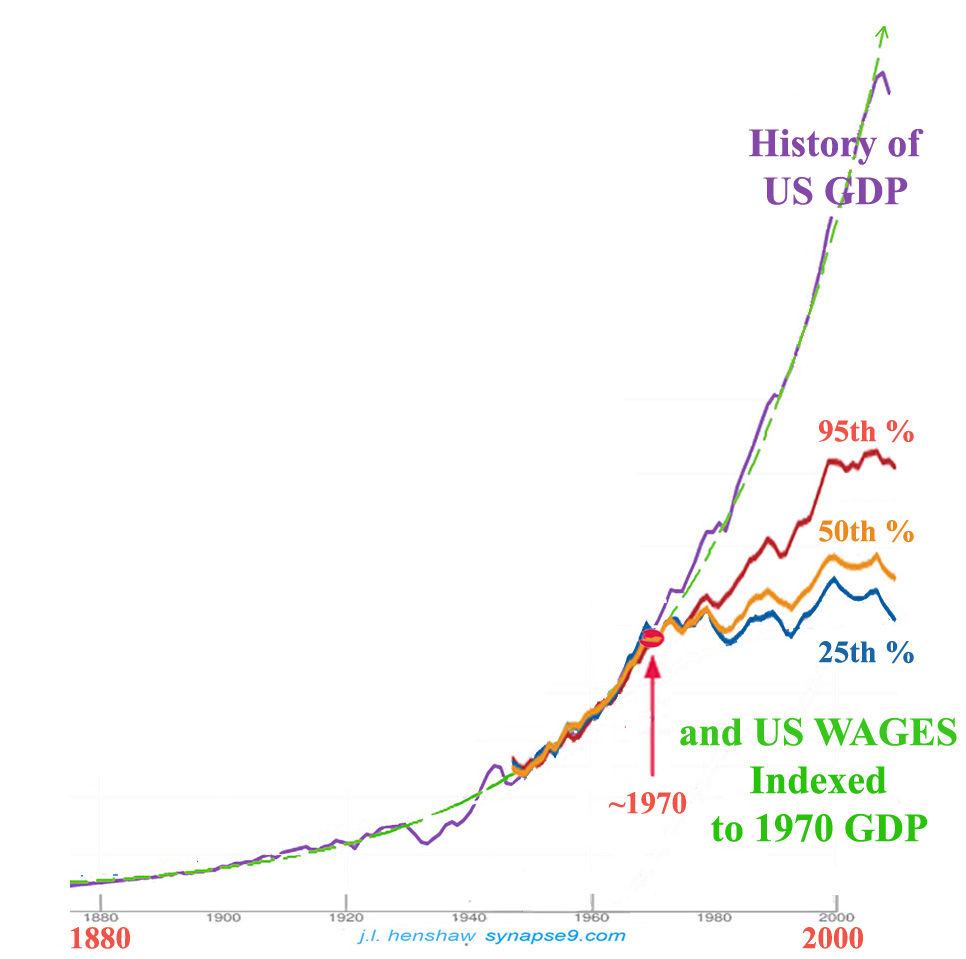
- : Labeled World GDP estimates from 1725 to the present —accurate since 1971. The difference in growth curve shapes is partly due to the sparse pre-2071 data.
– GDP Data – OWD: https://ourworldindata.org/grapher/global-gdp-over-the-long-run
II. THE SYSTEMS THINKING WE ALREADY KNOW – I’m a senior natural systems research scientist who’s been trying to shed light on some of these fundamental errors of perception that seem to be at the core of our modern world’s struggle for survival. This approach originally came from noticing gaps in physics, you know, the kind that shouldn’t be there. But it took many years before I had the beginnings of a clear idea of what to do with them. One of them was the reliance of physics on math, which meant the field had no way to study how things began and ended.
Let me explain. Scientists, not nature, define scientific equations. So, equations of change over time would trail off to infinity unless someone defined them to begin and end at a particular time or change abruptly by a scientist’s arbitrary choice. The same goes for economics, the math for our life support system! This is part of why it’s not working when, indeed, extrapolated to infinity.
Both of those illusions of math seem to come from the many centuries of our public lives relying on increasingly rigid thinking, like abstract rules, when nature presents us instead with highly varied kinds of resilient, lively, flowing systems of working relationships that themselves evolve into and out of existence. Empirical systems science is then a study of reliable but not rigid understanding. So it is also a little more focused, but not so different from what people do every day. We all spend our time looking for one after another sign of change or opportunity, or of what may be approaching, reading and getting a feel for the contexts for changing relations.
Doing that scientifically means asking key questions and looking for specific signals and patterns, more record-keeping, exploration of more related contexts, the added boundary testing and careful feeling for surprises, hoping not to be blinded by assumptions, reading situations, playing with hints of irony, and following up to confirm possible connections, all the fun mental journeys that help us get along. So it mostly works in context but also alternates with simplifying patterns to abstraction, not to follow, but like symbols, as handy guides to the questions that come up at different times. So, in that way, it’s the oldest science of all, what we as a species spent time learning from for the last million or so years as humans began to rely more on reaching for the limits of information, art, insight, connections, and feeling. The pace of that learning greatly accelerated around 60 to 100 thousand years ago, as we discovered how to form reliable language, with sounds that pointed to things and patterns in nature to our feelings and experiences with them. That “genome of language” seems to be what made it possible for all languages to collect and share useful meanings for the same things and translate them from one language to another.
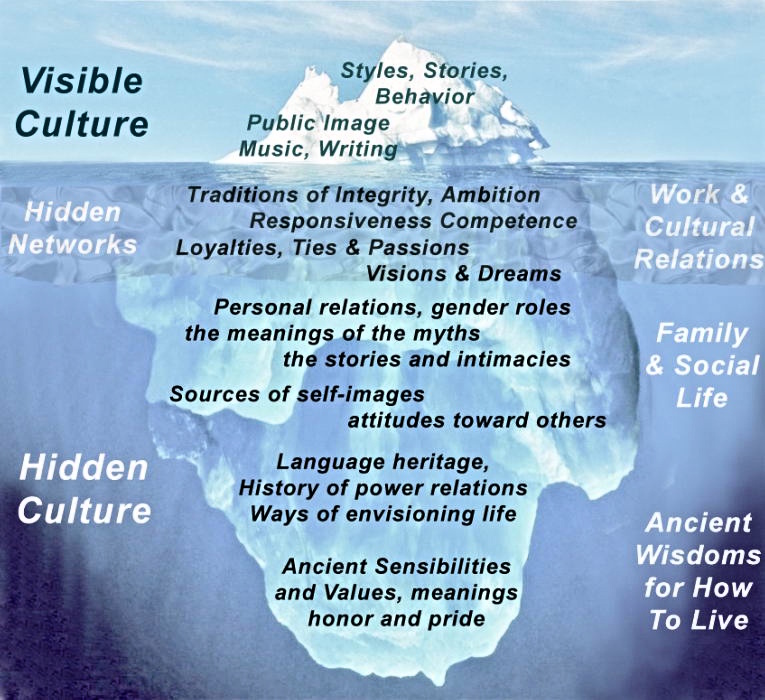
Had language just been an accumulation of popular hearsay and heresy, as much of language seems to be becoming today, it would never have become such a very useful way of storing, comparing, and improving on useful insights, feelings, designs, values, and ways of working. The surprising thing today is that in so far as nature is still here, the forms of language that so effectively connected our minds to nature are, too, just sometimes hiding in the root meanings of the words we use all the time, still there, just never cut from the branches and trunks of natural meaning they grew on. While their natural meanings do “have definition” and are related to others. ”Their meanings” are “not defined,” though, in the sense of being fixed by some rigid specification. Instead, they are recreated again each time we learn from their rich histories of usage, like new flags waving what we all find in the commonly recognized aspect(s) of nature they point to.
Do you have a podium?
What do you think humanity should do now?
We’re mostly very nice people, but we do not know what we’re doing. We always want to find out, though.
Other people need to hear what you really think if you can find a way.
_____________________________________
III. THE MEANING OF OUR OLDEST DREAM – What seems to be one of humanity’s oldest hopes and dreams is for there to be some great force of good to call upon as if we still had our parents to rely on or a God that might step in if problems got bad enough. We do experience the natural form of that in all the systems that we are part of and that we interact with. The word “system” came originally from observing things that held together and have experienced real “unity” and “cohesion” when part of something powerfully good for us.
Many kinds of natural systems that hold together are also organized to care for all their parts. Our healthy minds do that, and healthy families do that, too, as do friendships, organizations, and communities. It’s how things that work well work. We always like it and are happy to take part in it, but the world we also made seems driven to be at war with itself and nature, against nearly everyone’s wishes, but we just don’t see why. We might have thought we were living peaceful lives, but something seems to consistently blow things out of proportion, inflaming conflicts inside and out.
There are exceptions, but that’s been happening for at least five thousand years, and mostly for the world’s most productive cultures, starting with what seemed like wonderful traditions, leading to their terrible entire societal collapse. That kind of collapse also erases what it was that collapsed, as the tower of Babel was recorded only as disunifying the multiplication of languages and fragmenting culture. Both the Greek/Crete “Atlantis” and the Roman collapses came from the great success of intelligent, egalitarian, caring, and creative cultures, only to vanish mysteriously, of course. That’s what’s currently straight ahead for us, too, as our global system of stimulating human creativity led us to fight with and exploit each other as we destroy the only habitable planet we know.
Part of the secret is that Growth systems self-organize to work as a whole AND double in size and complexity again and again till something changes them. If they fail to find how to cooperate, nature erases them. From the smoothness of the economy’s global curves, it is clearly working as a whole, coordinating its parts. It’s regularly doubling its scale and complexity, as well as the suffering and conflicts between its parts while degrading its environments. If it is working as a whole, then why isn’t it taking care of all of its parts? It seems to be taking care only of the forces pushing itself and its environments over their last thresholds of growing instability, conflict, and exhaustion. It’s a failure as far as nature is concerned and approaching the time to erase itself.
All systems are self-organized around how the parts smoothly fit and cooperate. The long-term economic curves show how effectively increasingly educated people all over the world are working together, totally unaware of what they are now working on. To grow, systems naturally design themselves to work as wholes, smoothly coordinating AND responding to changing conditions to stay out of trouble, all that is 99% hidden from view. That natural self-coordination comes along with the system as it changes purposes, too.
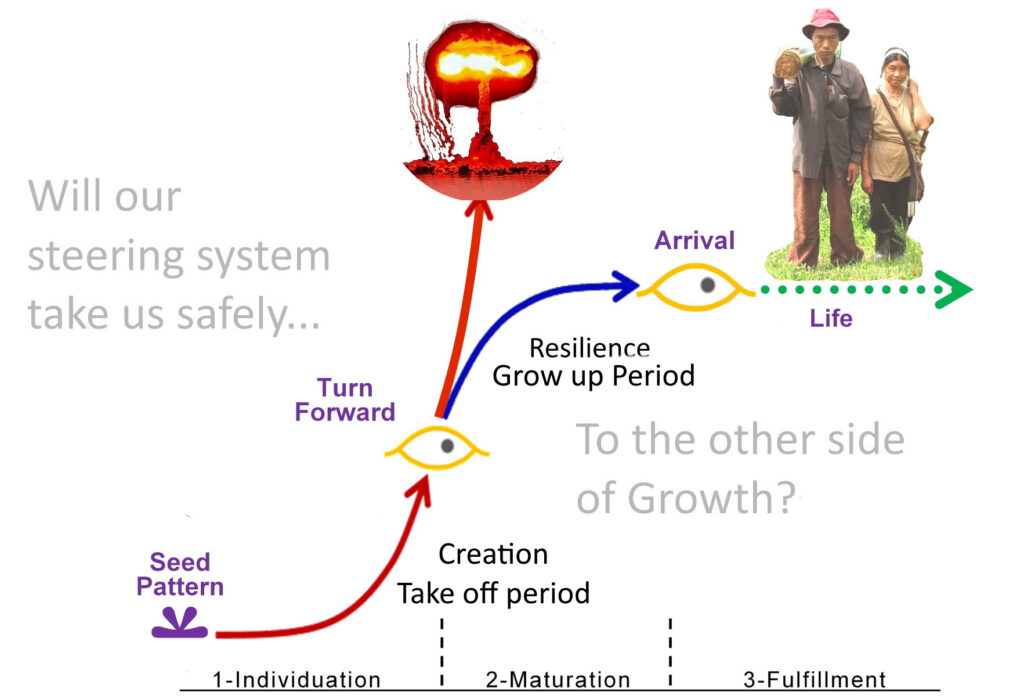
Any growth system has to change purposes, though, something no one has discussed yet, it seems, either to keep multiplying and stop responding to the suffering and dysfunction it creates or the healthy way to respond to limits to multiplying, turning the same resources to new purposes, to make sure it doesn’t stop caring, to perfecting its designs and making a good home in a stable environment, … i.e. what we all did when “growing up.” Civilization just made the wrong turn.
Look around. All sorts of new lives successfully transition from emerging to maturing; some quite smoothly, and others struggle, sometimes getting the help they could use or not. “Transformations” rely on chains of reactions between the parts as they interact to their “reading the signals,” sometimes like automatic reflexes, other times as explorations of new territory, as they find and change directions – the whole system steering we see everywhere things work.
We’ll need to collectively master that to survive on earth. It can go in alternating phases of experimenting and maturing, as the course of an education or career does. It’s in growing up that any system finds itself and its freedoms.
Making life work for all our world’s parts is the trick; creating a kind of hologram of every part represented in its best way to serve the whole, as the natural goal for systems able to steer is what we’d need to focus on for some time. The role of the parts is always to share and learn, notice good, bad, fresh, stale, and other kinds of useful and enjoyable ideas, to “get the signals” to “step up” or “take off” to reorganize our way of life, follow the paths of all successful new living systems, moving from multiplying our designs to fulfilling them. It’s not erasing the primacy of creativity but finding its right place, taking part in the new focus on caring for and perfecting the many designs of existence that every beautiful work achieves.
For either kind of growth, it is how the system steers that takes it where it’s going, responding to internal and external signals as navigation, so the system’s profits to enable it is changing lasting purposes if we want our two hundred thousand years or so of accumulating wisdom to survive.
________________________________________________
Author References:
Research site: Reading Nature’s Signals
http://synapse9.com/signals
Original Draft of Pathways article
Pathways to System Change
Papers:
(2024). A People’s Systems Science [GST/n]: Weaving Abstract & Contextual Systems:
Telling Them Apart & Aligning Their Parts. ISSS 2024 Mtg.
Draft Paper https://synapse9.com/_ISSS-24/HNS3-PSS%20MS-v.docx
Talk Slides https://synapse9.com/_ISSS-24/HNS3-PPS-1.pptx
(2023). Emergent Growth of System Self-Organization & Self-Control: Contextual system design, steering, and transformation. Systems Research and Behavioral Science
Author copy https://synapse9.com/pub/2023_sys-SelfOrg&SelfControl.pdf
(2022). Holistic Natural Systems – Design & Steering: Guiding New Science for Transformation. Journal of the International Society for the Systems Sciences. Presentation Jul 9
https://synapse9.com/_ISSS-22/HNS1-MS-Design&Steering.pdf
(2021). Understanding Nature’s Purpose in Starting All New Lives with Compound Growth: New Science for Individual Systems. Journal of the International Society for the Systems Sciences July 2021.
MS https://synapse9.com/pub/2022_NewSysSci-IndividSys.pdf,
Supplemental https://synapse9.com/_ISSS-21/ISSSJul11NewSci-IndividSys-supl.pdf
Oct 2 Talk https://www.youtube.com/watch?v=0plSWMjnTHQ
(2019). Growth Constant Fingerprints of Economically Driven Climate Change: From 1780 origin to post-WWII great acceleration. draft https://synapse9.com/drafts/2019_12-GrowthConstFingerprintsOfCC-preprint.pdf, in Cornell arXive physics preprints https://arxiv.org/abs/1911.04340 Submissions to: Submissions to Nature Climate Change, IOP, Ecological Economics, Anthropocene, Springer Climatic Change, PLOS.