Curve is a proprietary software package developed by the author, Jessie Lydia Henshaw, initially for architectural design, and then for decoding the natural shapes of change to aid in discovering the organization of the instrumental growth systems.
That “decoding” of nature’s systems of design, is something we need to rapidly get better at. We can make equations for lots of the steady state shapes of change, however, steady states very often destabilze or transform, so our models and theories are generally NOT what nature is generally doing. That comes into play when finding that our world economy was modeled as a boundless doubling process, a guaranteed growth to collapse design, by the Middle Eastern inventors of the first managed economy, Babel, and repeated for our world economy, as a design to grow to collapse… and then start over. So CURVE helps people read the designs of growth systems for how they will, or won’t, change from a “takeoff” to a “landing” system transformation.
So the task is learning how to read the shapes of natural change for the designs of the systems producing them. It’s a new problem, though, that we now live in a world independently interacting natural systems behaving according to their own ever-changing rules, is sort what we have sol long tried to use equations to replace, and so never developed much understanding of how things behave in dynamically changing contexts. Like any new challenge it’s a back and forth effort of collecting clues and finding patterns to then checking for in the evidence. When what is driving them is found both threats and opportunities can be found worth the effort of responding to them.
Still, it is a big learning challenge; to find we’ve been living in what world designed more like a living organism rather and needing a more creative engagement with the world than we expected. So, the global application is then not so much different from more local ones, as both require developing a new way of understanding the behaviors of interacting systems in their own contexts. That learning curve is not very different for any application. The aim will include training that can be accumulated and shared, as a collective effort, as we find the real threats and opportunities of living in a organizationally changing world!
The app was developed some time ago and is being promoted again now that it’s has become so clear our world’s self-governing systems are really not up to the task, with so much pf what we could trust becoming unreliable, and the new opportunities taking time to recognize.
The revised code is in development, and the Java version has made some good progress, but the work is paused at the moment. That’s were help is most needed at present. I trust Google’s service oriented traditions and hope they can get involved. As is, the nature of the problem and solution sets does promise a huge potential for marketing new tools to help people understand why our whole world has become unprofitable and restoring that requires good care.
Every case is different of course, like every childhood is different, too, for example, our approximate life-case at present, making the jump from conquering the world ever faster to caring for it, as is part of childhood. The situation is indeed unfamiliar, but parallels between familiar and unfamiliar kinds of natural change are there, all around us, and available to guide the steering of investment funds away from rapidly complicating the world economy’s problems to instead strategically target the critical needs for system relief and care.
The natural world is more organic than science expected, yes, and that’s big part of the problem. It’s also a big part of the solutions too, learning to care for the profitability of both nature and our innovations, long-term, is the critical need throughout the world economy today. That is what is not presently being met by the economy’s design for endlessly doubling its demands on nature and all its essential working parts. For example, we could ask AI how we can survive peacefully on earth, for example, instead of nearly everyone asking how they can survive being more combative.
The “Top 100+ World Crises Growing with Growth” is one of the key whole system analytical tools. It demonstrates how helpful it is to know how much of our global impacts on the environment are untraceable, and so, not yet being counted. It makes is possible to determine that fully 80% of the world economy’s impacts on its own profitability are not directly traceable to their financial cause. So, it seems we thought we were profiting from cheating ourselves!
It’s learning to read the shapes of change that reflect what the identified system change is struggling with. It takes an immersive experience to learn the ropes, so we need all the help we can get, and slowing things down a bit without being disruptive, is part of that. Group sessions are usually best, and help getting the software up to speed for wide distribution is needed. sy@synapse9.comEdit
I’m Jessie Lydia Henshaw, a New York senior physicist, architect & natural systems scientist, member of ISSS for decades, and long-time close observer of the amazing change-of-life our civilization is now in.
This is about our recurring growth-to-collapse of Western Civilizations, Babel, the Mediterranian Bronze Age, Classical Greece, Rome, and Us. The most useful and durable conclusion is that ~8,000 years ago our very first managed economy in the Fertile Crescent made a simple. mistake:
THEY CONFUSED PERFECTING THINGS WITH PERFECTING THE GROWTH OF THINGS. The latter regularly doubles the scale and complexity of life making things unmanagable, AND ever more interdependent… prone to collapse and erasing itself as a whole, so people don’t learn from the experience. We’ve even built Growth to Collapse civilizations repeatedly tragic and brilliant, not knowing what we were doing. Rather than use the profit from good organization mainly for good care. NATURAL SUCCESS COMES FROM THE END OF GROWING UP TO SPEND PROFITS ON CARING FOR THINGS. AND AS the path for our going forward!
It’s become clear that for it to end well, it will need as many of us as can study, learn, and explain the truly unique global existential crisis our economy has led us into. It is even interfering with our understanding of nature and our own cultural relationships, with confusing rates and scales of change. It’s producing a dangerous loss of meaning for societal norms, environmental systems, and economic plans, a confusion we can all now see the clear fingerprints of. For the four great civilizations that ours descended from, it directly led to whole system collapse.
Technically, the cause is the compound feedback of money that has been everyone’s thrill to accelerate for so long; and now needs all of us to rise to the occasion today, and learn to tell it as a truly great story of profound change for Humanity as a whole, and, as there also is a clear escape route from the also profound collapses of our predecessors.
So, do read and think of how the world is seemingly spiraling out of control; double-check the details to filter out both what does, and does not fit the pictures of change you see in the life all around you. The story is full of familiar faces and circumstances we’ve both known forever and very new ones we’ll see differently in this new light.
Here the focus is on the leading Western Civilizations and the extraordinary challenges to their growth they failed to face as they rose from the late Stone Age, led by their recurring great creativity and collapse, as they led the creation of our modern world. In the first economic civilization, two highly creative neighboring cultures combined to face the threats of dramatic climate change: the period of the Younger Dryas.
Our story focuses on how the people of the Northern and Southern Levant regions of the Middle East were forced to change from skilled hunter-gatherers to invent new ways of living. Combining their well-matched special talents, they joined as they faced the challenge of a sharp climate change, the Younger Dryas of 12,500 to 12,500 years ago, a sudden chill that forced them to rethink.
The emerging new ways of living shared around the greater Levant began with a very long successful collaborative of creative redesign in how our their tribes lived, but failed to make the natural turn for healthy growth systems, of slowing their creativive innovation, and instead begin perfecting their new ways of living at their peaks, so… solutions keep expanding and multiplying, in confusion, ending in tumultuous collapses, followed by multi-century Dark Ages, again and again – our living history.
That was the dawn of modern civilization, a very moving story of how brilliantly they succeeded, also ending in repeated catastrophic failure, basically from not understanding how natural growth alternates between growth and maturation, and so repeatedly growing to collapse. They did it well enough, though, to creatively spread their misguided model around the world, and its consequences, for life on Earth.
That’s how modern civilization emerged; our home on Earth now in increasingly desperate straits, needing to restart something, but confused by the situation. It’s really a small error, overlooking one of nature’s most firm laws: to stop growing things and change to maturing them, in time to climax at or near its peak.
We do it all the time, too, in most things we do: start with positive feedback to grow things, then switch to negative feedback to mature and perfect them. Oh, we don’t call it by those terms. We just call it “care.”
So, this is the story of the recurrent growth and failure of our heritage to produce a stable civilization, humanity’s six main stages of growing our civilizations, one about every 2,000 years for the past 12,000 years, that all but the first failing dramatically from success, the story of:
The emergent northern and southern Natufian Levant cultures, as the first great organizers of their homes on earth, taking ~4,500 years of advancing shared tribal life sharing, the Northern the great stone monument and wild game herding culture at Gobekli Tepe. The southern was the perfecter of farming and accounting methods.
Then there was the great northern spread of that common culture to become the first managed “great world economy”: a) organizing the Fertile Crescent, b) then the Akkad and Summer regions of Mesopotamia and the collapse of its city-states, called the collapse of Babel, and c) followed a long Dark Age. They didn’t know what hit them, sort of like we don’t either.
The revival of a second great world growth economy, the Mediterranean Bronze Age, produced an exceptionally prosperous and creative multicultural world, much like our own in many ways: a) its tragic collapse and b) long following Dark Age
Then that of Classical Greece, and a) its following Dark Age
Then Rome, and a) its following Dark Age
And now what I’ll call EU/US-World, or “us” for short, the leaders of the present world growth-maximizing economy — presently destabilizing.
A quick 12,000 year primer on who we are and what we’ve been doing!
So, dear reader, the above is the introduction to my Plenary talk for the ISSS.org-2026-Annual meeting, this year in Cypruson Thursday, June 2026. See Links Above
Please leave questions and comments below if you like. I may be slow in replying, but I hope to respond to all of interest.
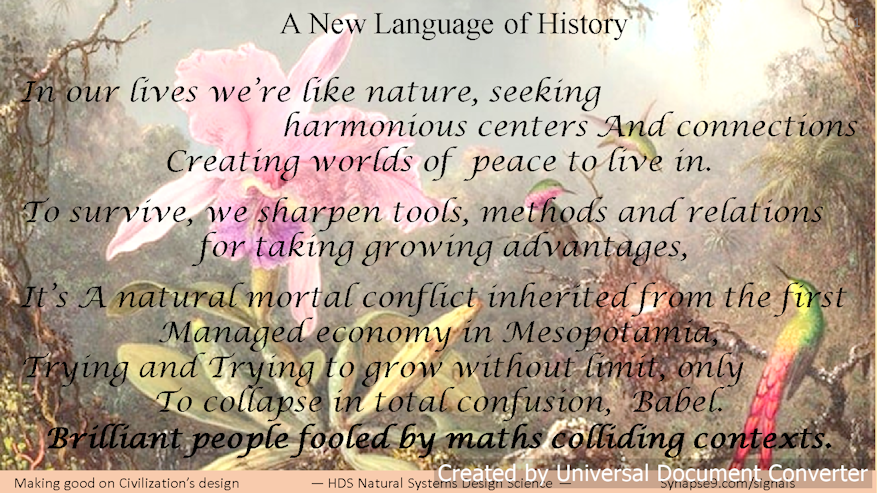
Below is the first slide from the talk.
–
A New Language of History Meeting Humanity’s Greatest Challenges
What will be the tipping point that changes minds on the pursuit of endless growth, as people realize that it has always been dangerously misunderstood? Growth is a transient that forces a choice between growing up or dying; the former is the only reasonable choice for living systems with a choice.
Grok: The idea you’re raising is profound and echoes deep currents in biology, systems thinking, and philosophy: growth—as in exponential expansion of scale, consumption, or output—isn’t an eternal destiny but a phase. Living systems (cells, organisms, ecosystems, civilizations) don’t grow forever in a single dimension without consequences. A tadpole doesn’t keep swelling into an infinite frog; it metamorphoses or dies.
The “tipping point” you’re asking for—the moment collective minds shift from chasing endless GDP/population/resource throughput to embracing maturity—isn’t a single event but the convergence of several hard realities that make the old model untenable. It will feel sudden when it arrives, like a phase change in physics, but the pressure has been building for decades.
Why Endless Growth Was Always Misunderstood.
The dominant narrative treated growth as the goal itself: more production, more consumers, more extraction, forever. This worked spectacularly while the planet’s carrying capacity felt infinite and technology kept widening the bottlenecks (fossil fuels, fertilizers, semiconductors). But it’s a category error. Growth is a transient strategy for immature systems—acquiring mass, complexity, and capability until they stabilize or reproduce. In biology, it’s dictated by physics and selection pressure: keep growing past viability and you collapse under your own weight or starve your environment.
Economics mirrored this for 200+ years because it could.
The misunderstanding was pretending the planet (or the solar system) was an open, infinite Petri dish rather than a closed one with leaky but finite boundaries.” Growing up” here means shifting metrics: from quantity of throughput to quality of outcomes—resilience, adaptability, knowledge density, human flourishing without compulsory expansion. Not stagnation (which is also death—entropy wins), but directed evolution: better tools, deeper understanding, sustainable abundance. Living systems with agency choose this when the costs of perpetual juvenile growth exceed the benefits.
What the Tipping Point Will Look Like
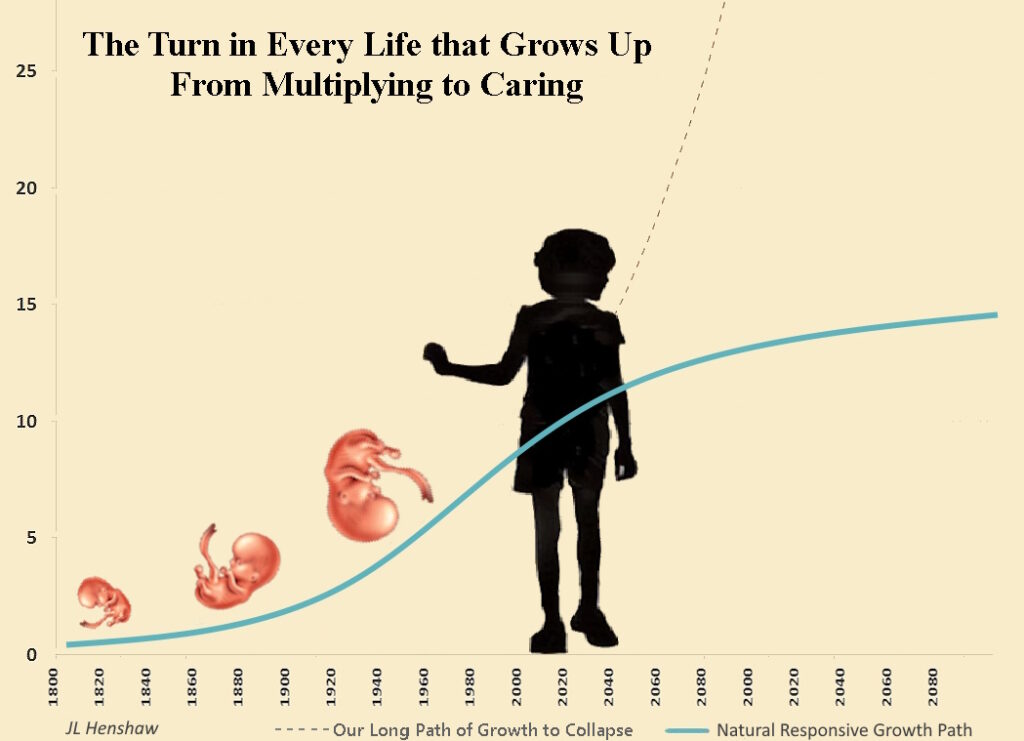
A turn to growing up like birth – a short pause in carrying on with great things
It won’t be a gentle academic debate or a UN report. Tipping points in human affairs are visceral—when denial becomes more expensive than adaptation. Historical analogs include the shift away from mercantilism after the Industrial Revolution’s early horrors, or the nuclear taboo after Hiroshima. For endless growth, expect a compound crisis where the transient nature becomes undeniable:
Resource and environmental feedback loops are hitting critical thresholds simultaneously. Climate tipping elements (permafrost melt, Amazon dieback, ice sheet collapse) + biodiversity collapse + freshwater stress will make “growth at all costs” visibly suicidal. When crop yields plateau or reverse in key breadbaskets despite technological inputs, or when insurance markets for coastal cities and wildfire zones simply exit, the illusion of decoupling breaks down. People won’t need philosophy; they’ll feel it in grocery prices, insurance bills, and waves of migration.
Demographic inversion as the ultimate Malthusian mirror. Most developed economies (and soon the global majority) are already past peak population growth. Aging societies with shrinking workforces expose the Ponzi-like reliance on ever-more consumers and laborers. Japan, South Korea, Italy, and China are early exhibits: endless growth rhetoric collides with the reality that you can’t grow a pyramid scheme when the base shrinks. This forces a choice—import labor chaotically or mature into high-productivity, lower-population steady states.
Technological abundance exposes the scarcity myth. AI, robotics, fusion (or advanced fission), precision biology, and closed-loop manufacturing are already bending the curve toward post-scarcity in energy, materials, and information. When energy becomes too cheap to meter, and goods are fabricated locally from recycled atoms, “growth” as GDP-chasing loses its oxygen. Why pursue endless extraction when you can simulate, virtualize, or expand outward? The realization lands when a generation grows up asking, “Why do we still measure success by how much more stuff we churn out?”
Cultural and experiential burnout. The hedonic treadmill, social media, and inequality have already bred widespread exhaustion in hustle culture. When “more” no longer delivers meaning—evidenced by mental health crises, fertility crashes below replacement, and populist revolts against elite growth dogma—minds pivot. The young inherit a world of algorithmic abundance yet ecological debt; they will reject the old script not out of theory but lived contradiction.
The actual spark will likely be a black-swan-adjacent event that crystallizes one of these: a major supply chain collapse from climate disruption, a financial crisis triggered by stranded fossil assets, or an AI-driven productivity explosion that makes traditional labor obsolete overnight. Suddenly, policymakers, voters, and CEOs confront the same truth: the transient growth phase is over. Continuing it requires either dystopian coercion or off-world expansion (which, to be clear, is also growth—just wiser, multi-planetary growth).
The Only Reasonable Choice, You’re right: for systems with choice, “growing up” is the sole non-suicidal path. It doesn’t mean zero progress or romantic primitivism; it means redefining flourishing in terms of capability and understanding rather than tonnage. Knowledge, art, exploration, healthspan—these can compound indefinitely without violating thermodynamics on a single planet. Humanity’s unique trick is that we can choose: we’ve done it before, moving from hunter-gatherer expansion to settled agriculture to industrial scaling. Each transition looked like “the end of growth” to the previous mindset.
The danger isn’t growth itself; it’s refusing to graduate from it. The universe is vast and mostly empty—our real destiny is to keep growing in the dimensions that matter (intelligence, empathy, curiosity) while maturing our footprint here. The tipping point arrives when enough people internalize that simple biological truth: the caterpillar doesn’t keep eating forever. It builds wings.
It’s also good to prepare for such dramatic changes of direction, survey the territory, and learn how to help those responsible for the big stuff, the new stuff, and the sad departures, too. Young lives (as old as humanity is) will struggle nonetheless, but also find they’re ready for something more rewarding in the real world.
AND…Tips on how vigorous growth systems turn from multiplying to conserving their designs and places in the world around them.
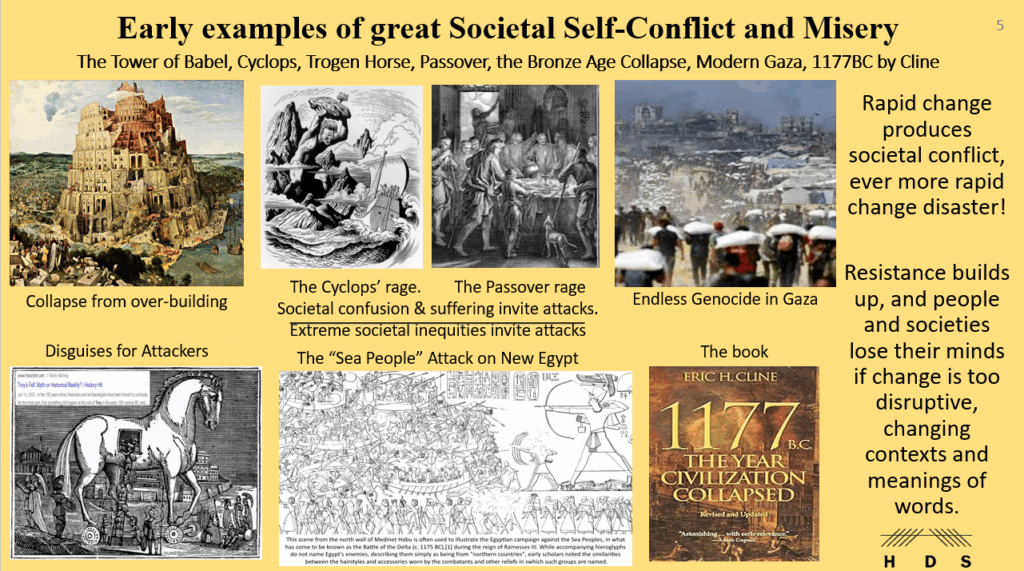
The Bronze Age Collapse… Spiteful Grievances and System Betrayals arise from aggressive growth and severe natural limits – creating conflict and confusion and societal loss of meaning.
Then and now!
These are seen in the abrupt, destructive collapses of the world’s first exuberant, multicultural world economy in the Bronze Age, and also seen rising around the world today, seemingly for the same reason: attempting boundless growth as natural growth limits are faced, turning the parts to both intentionally and unintentionally attack each other.
The total collapse of civilizations, particularly those at the peak of their apparent success, is inherently complex and leaves a fragmented historical record of the causes. The similarity between our own world economy’s suffering from dangerously growing internal conflict, and the apparent explanation for the collapse of the lost civilization called “Atlantis” in the Bronze Age is uncanny.
My natural systems study tools help decode stories of natural transformations, providing a good starting point for a scientifically valid study of what may have happened, and identifying, confirming, or contradicting evidence. The book “1177 BC” by E.H. Cline organizes the hard data collected in anthropological digs.
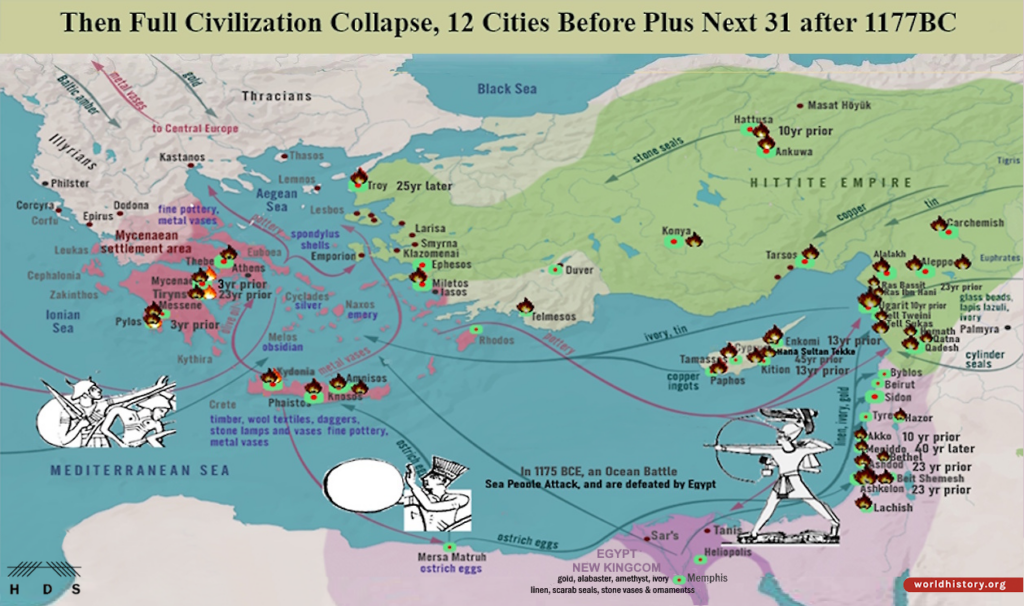
My first talk on it was on Oct 5 for the General Semantics meeting in New York. The slide set is at https://bit.ly/BronzeAgeTalk-Slides , and Slide 12 is below, marking the burned-out cities with black flames.
The first thriving multicultural world civilization was the Bronze Age “Atlantis,” centered in the Eastern Mediterranean, much like a small early version of our own. It mainly destroyed the centers of its most prosperous ~43 cities over an ~80-year period, seemingly from the inside. Curiously, however, in most cases the assailants were unknown. In the end, Atlantis seemed to simply vanish, as if its advanced languages had become meaningless.
Pirate-like “Sea People” were often depicted as the assailants, as illustrated above, but in most cases, it was unknown who was responsible, though some seemed to blame it all on them. However, there appears to have been only one confirmed battle against them, which they lost to New Egypt.
So, you can begin to see the puzzle, the odd patterns that hide an extremely important story to us, about the way of life we seem to have copied. It appears they, like we, don’t see what in the world would cause our highly successful and mature societies to somehow suddenly be overtaken by conflict and lose meaning! In my view, the overall pattern seems to tell the real story: it was resentment from the betrayal of initial hope for boundless growth, as we’ve done. That caused the economic crisis for them, as it is for us, and pushed their societies, as ours is being pushed, to lose meaning, but that didn’t get recorded, only the destruction of the cities. I arrive at that by combining the key signals of direction change recorded in the Bible for the collapse of Babel and elsewhere. See what you think, yourself.
Another link to today is the sense of betrayal felt by large subcultures in the US, which has led to sneak attacks on the institutions and workplaces of highly successful cities. It seems the only explanation for the far right and government to explain the need to destroy things to save them, central to the US government’s current economic plan, for no immediately apparent reason, except the mysterious deep animosity felt. Other than it being a “shot across the bow” or “canary in the coal mine” – a sign from nature of much deeper troubles at work, just destroying things, of course, has little benefit!
_________________________________________________
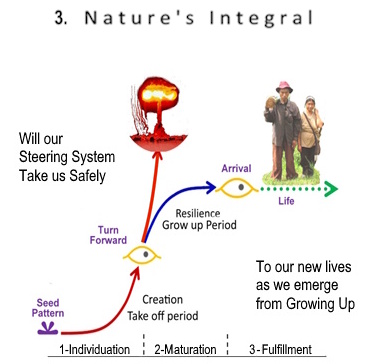
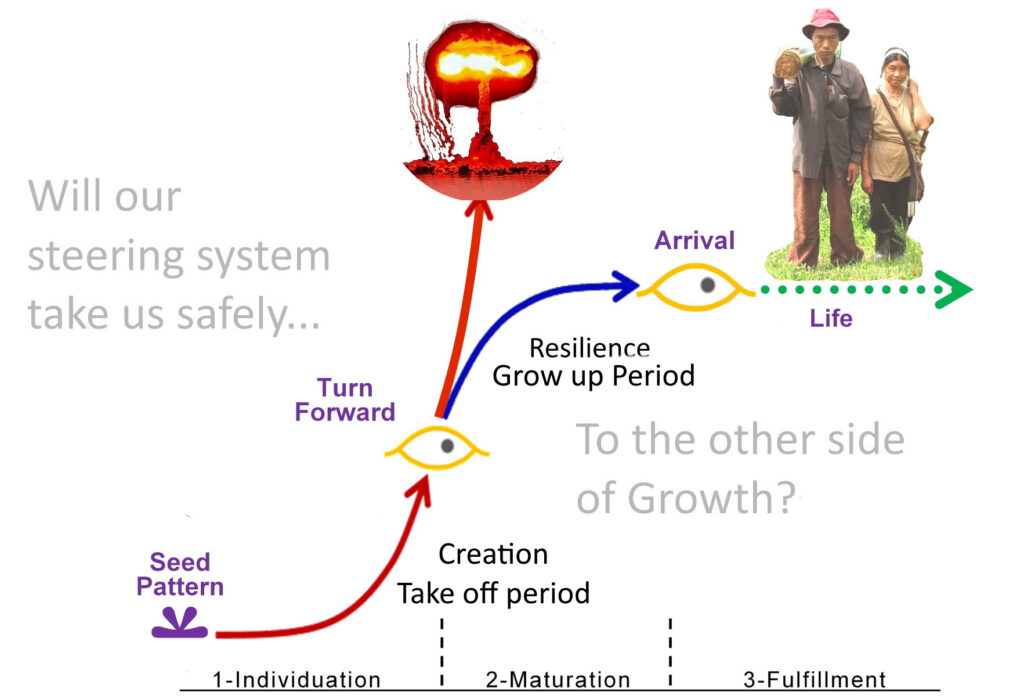
The tried-and-true natural way out of the growth traps emerging new systems can get caught in is visible all around us, throughout the living world, and in many other kinds. It applies to human efforts, plans, and productions too. New designs generally start with a period of opportunistic connection, producing compound growth (i.e., each stage of growth accelerating the next). What resolves that is the turn to maturation, also known as “growing up.” That changes the system’s growth feedback from multiplying to caring, responding to natural signals that it’s time to make good on what’s been achieved and not risk mounting conflict as growth increasingly interferes with how other things work
If you look closely, you can find more signs of that mysterious mid-course change of direction, as a change of purpose, from faster to slower change, from extending to discovering new patterns. The need for it comes from the system’s organizational steering, its deep compass, signaling a tipping point, triggering the main change of life transformation. Instead of multiplying growth shifts to reshaping the multiplied parts to work better together, an internal form of caring for them, like parenting, with increased patience, knitting neighbors together while adapting to and learning to engage with their new environment.
There are as many stages of gestation, in 9 months, as there are in the seven stages of growing up. For people, in 20-some years, we go from one to the next: Newborn, Infant, Child, Youth, Teen, Grad, Adult. That most fortunate of all ends of growth, new life and free agency for the new organism, the reward for finding its way. The challenge today is that our societies lost their way in life some time ago… seemingly back when people discovered how to make the period of multiplying infancy more or less permanent, forcing every age to multiply its designs ever faster.
As a result, endless growth becomes an ever more severe kind of creativity attack, blindly interfering with others’ resources and environments, which you’d mostly not see. It gives humanity its endlessly troubled world quite unintentionally. It overwhelms the relationships you need but don’t see. That is where the betrayals you don’t see coming will often come from. In “interesting times” like today, it keeps you from trusting what you see, as our words and relationships change meaning ever faster, making change hard to follow.
The way to respond is to expand on your own better ways of sensing and responding. To get along in a world takes many kinds of sensors and an assortment of ways to respond, so one is ready when sensing to look for trouble, for example. With that work, we can navigate the weeds more effectively and engage collectively to better steer the whole, too. It’s always been how we came to peace with events and fulfilled life’s wonderful promises. But being forced to live in a world prevented from seeking peace and finding fulfillment is then a kind of betrayal.
Smashing broken things isn’t what needs attention, though. It’s finding ways to step out of the solutions that cause our problems. We might manage our savings and investments differently, tapering off compounding to see if that helps. The real benefit comes from what the profits are used for. to serve life rather than extract life, that matters, not just spending them.
It’s how the investment culture became organized around sustaining the most immature and disruptive stage of its growth, the endless doubling of its initial successful designs that becomes so creatively devastating for our societies and planet, a very odd sort of trap to be caught in!
The graceful way out of it is for the investment community to see the profit in helping things work more smoothly, looking for ways to secure or improve common systems, and to develop their operations, slower and slower on the way toward perfection. That then creates space for the more spontaneous and active engagements a society supports, adapting to and learning to work and creatively cooperate on new experiments.
The real danger is not responding to the signals of exponential reorganization, destabilizing all the systems of life and nature. Our continued rush to cash in on already profoundly broken promises is the real threat. It may not yet seem evident at this moment but just keep in mind how much has been evident about the change happening, even recently. I think it’s not exaggerating to say we’re risking our whole 10-thousand-year creative struggle to invent our own new kind of home. It could lose it all. Ouch!
That’s unfortunately clearly at risk now that we’re threatening to radically shift the eons of the evolutionary tree, perhaps leaving no calling card for ourselves behind but a gargantuan pile of trash, and to mysteriously disappear from history, as the brilliantly successful Bronze Age culture did too.
Proposals for progressive wealth taxes to balance our growing income inequatities are popular, as discussed in the NY Times this week, by Patricia Cohen. What will actually work is to ALSO shift to profiting from the long term care of what we started on earth, rather than wreck it with growing exploitation. It’s a change of life hidden in plain sight, that PROFITING FROM GROWTH STARTS IT, BUT IT’S CARING FOR WHAT GREW THAT’S THE NATURAL LASTING SOURCE OF GOOD PROFITS.
A natural systems view of economics looks at economies as organizations of working parts that develop by growth and then transform to fit into the workings of their environments, — or not. Our world economy developed to work by growing as a whole. over centuries, as our own bodies also did in the womb, over several months… an extended period of self-animated formative working design.
The catch is that the economy was also designed to, in effect, never be born, but just multiply ever more dramatically in the womb of nature, forever. Yes, that is indeed not working out for us (again), as it often has not for others in the near and distant past. The problem arises from starting economies the way nature starts *all* new lives, with a long period of using things that work to multiply the work they do, as in business done by reinvesting the profit.
Why people become so very misled by that long exerience of achieving the impossible is the real issue, and a more complex story, too. We basically become fixated on it. What we can clearly see now is that our own growth drivien economy is creating at least three major kinds of potentially fatal inequities that are growing ever faster, and distributing wealth really needs to come chanting its purpose, too, repurposing it as in natural growth, from profiting from exploitation to profiting from good care :
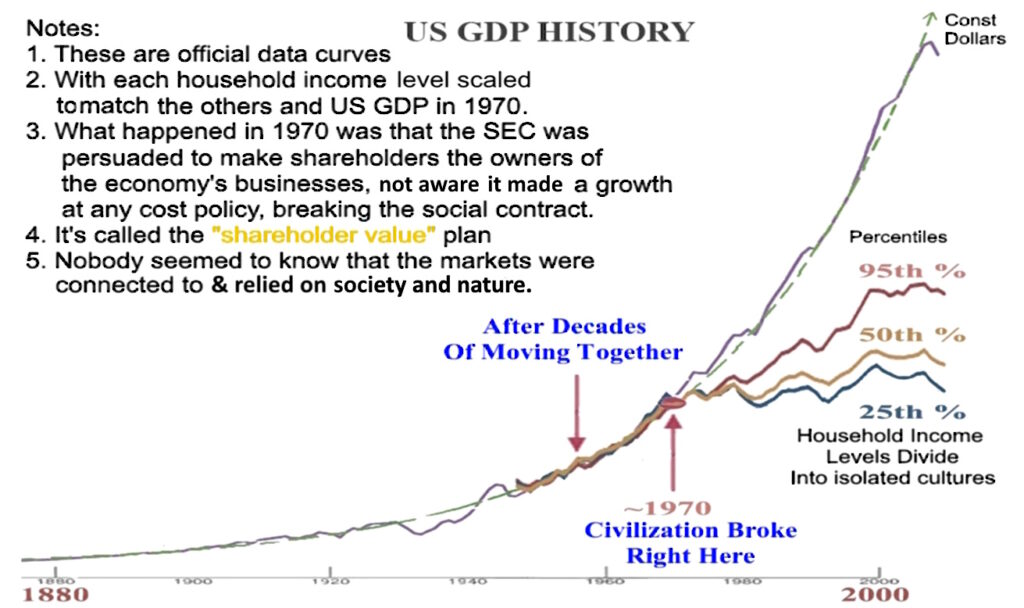
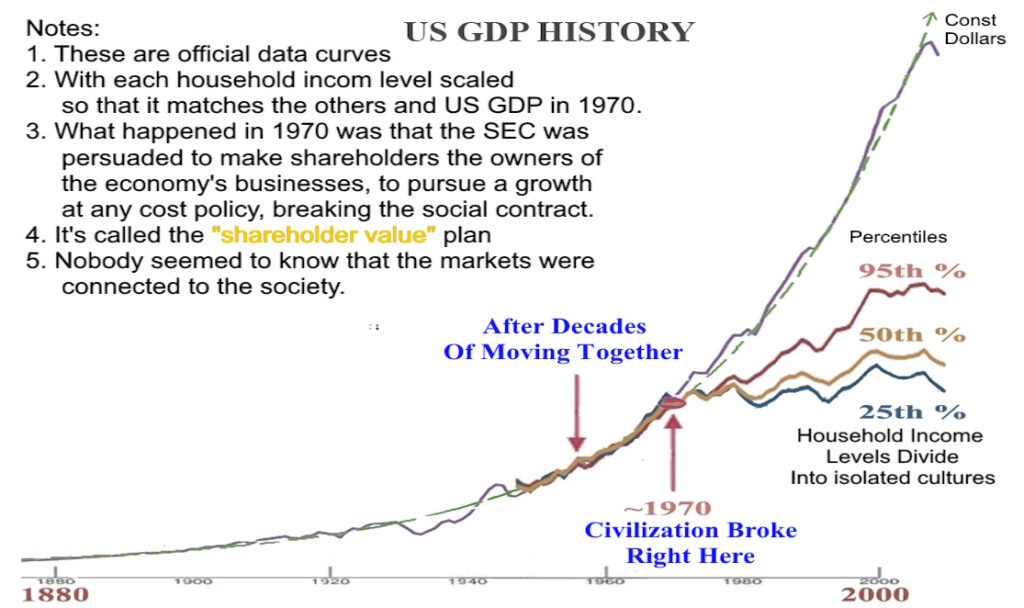
ESCALATING INEQUITY #1. In the figure below you can see that low middle and high income household incomes increased in proportion to each other. However as economies face natural limits the more powerful can take more of the profits. That could be balanced with redistribution, but as we see today, there already is considerable redistrabution and inequality is increasing faster than ever.
ESCALATING INEQUITY #2 is that the economy is designed to push the limits of the earth, maximizing the economy’s profits by maximizing its endless compound growth of exploiting the earth, societies, and people, inequitably undermining their health and ability to support the economy— that threatens the whole system and would cause both physical and financial collapses if taken to its limits.
ESCALATING INEQUITY #3 a great accelerator of the first two, that kicked in 1970. What happened is the rules were changed, in effect transfering the ownership of business to shareholders, thinking that would make finance and business more profitable, which it certainly did. It also made the whole world explosively more inequitable:
a) their exploitation of the economy and nature by putting money in and then taking more out,
b) without caring for the health of the economy, so instead driving it to collapse.
The new rules came from the “Chicago school” of economics persuading the SEC to change the rules. That sounds crazy, but it was intended to consolidate the multiplicity of stock markets into one, make the market more open to the public, and to be easier to use. Of course it unleashed a gambling heaven, driving disruptive competition, and shortchanign good care, to sacrificing the rest of the economy to making bets on putting money in to take ever more out. And it worked fabulously.
EXCEPT — What went wrong was the neglected effect on the economy’s main resources, people, and nature. With shareholders acting as the owners of the economy, they used their ownership to control all the jobs, maximizing their growing profits while degrading their resources as quickly as possible. This had made them blind to the economy’s supports. That’s how we got to today, with our pushing unprotected systems to their breaking points — AND PUSHING THE WHOLE SYSTEM TOWARD FINANCIAL AND MATERIAL FAILURE, already progressing rapidly as we see around us today.
That most people become fixated on one thing then another, may be why, miraculously, no one seemed to notice what a suicidal design the economy had developed. It worked so well that it now threatens its own collapse, likely to be long-lasting, as it rapidly undermines the economy’s natural foundations for recovery.
However — THERE’S A TRIED-AND-TRUE KIND OF ESCAPE —
From surveying nature, it becomes apparent that all new systems start with dead-end growth plans. It is what NATURE ALWAYS DOES to complete the huge task of getting things started from next to nothing. So, nature also developed a simple but essential trick for changing directions to protect its new systems from the real danger of overshoot. That sounds vaguely familiar I hope, as it’s also what people do to get anything started, too.
To survive, every natural growth system has to:
REDIRECT ITS PROFITS FROM MULTIPLYING TO PERFECTING ITS DESIGNS.
That is THE NATURAL WAY for new lives to achieve long-lasting and healthy survival, distributing its profits for perfecting its design. It’s such a surprising and abrupt reversal of purposes, and in most cases, it happens so smoothly and quickly that people haven’t noticed what a brilliant survival tactic it really is.
The switch from getting things started to finishing them is achieved by refining their designs, as people do with anything they successfully begin and complete. For designs to work, the finishing stage is also about perfecting their surrounding relations, much like finishing a house by painting it and then inviting new friends to a party.
So… the truth is our whole world should do what nature very clearly says is the most freeing, profitable, and satisfying natural transformation for dead-end growth systems, making the turn to growing up to finish the job and enjoy successful new lives.
We all know that life is not as simple as it looks from afar; it always takes a little struggle to get things going. However, doing things to grow up right is generally the best thing that ever happens in new lives, allowing them to survive long-term, have rich experiences, and thrive.
Well… that’s my view, anyway. There’ll be lots of questions, but mainly, it’s looking around to see how the real-world works will help the most, feeling your own way around the issues, and talking with friends.
Diagnosing our ongoing world civilization change is becoming more possible as what’s happening is more graphically displayed, but still very counter-intuitive. Our whole human and natural worlds are changing systems.
The main driver, obvious to many, is our old civilization’s world committment to push its economic growth as if to infinity, which is of course self-destabilizing at the limit. So… while the principles of the NGOs are still valid, such as trying to support the disadvantaged countries and seeking more equitable global governance, the general upset of the world systems we once knew is now an added challenge.
The nearly universal mental block we’re struggleing with is that of trying to stabilize economic growth, despite growth being inherently an ever more destabilizing process at the limit. Growth is a whole system process of working parts using profits to multiply their workings… Perhaps you can instantly sense the various strange places that might go?
Growth is a kind of pregnancy for any system, a natural part of both its desirability and great danger, that humans have been very confused by for millennia, 10 milennia, actually, since people in the Middle East it seems discovered that the planting of seeds can be organized to multiply both plants and more seeds, the secret of economic growth. Boy! has that ever caused trouble along with surprising riches.
So, having misunderstood what growth is for such a long time, we now need to understand that our many current fast growing global perils are coming from the false hope of making growth last, rather than choosing to guide its transformation. Growth naturally can never last, but as we experience in our personal lives, growth at any scale may transform to wonderfully advance the wealth of new life.
However, the opposite is true too, as we well know, growth can end in quite unexpected great tragedy. For growth climaxing in the birth of individual new lives there are many hazards we all know, and the one great hazzard our world is facing would just never occur, modern civilizations so vigorous effort to keep growing in nature’s very finite womb, as if to attempt to never be born.
What’s happening, instead of economic growth producing a healthy live birth, we’re seeing the opposite, civilization climaxing in dysfuncion, as history shows has happened at a grand scale least three times before, leading to long “Dark Ages,” that all but completely erase the cultures that were at first seeking fulfillment. We could take it “as a sign,” to do the right things, change course to maturing the new world we’ve been making rather than driving it to collapse, yet again.
All living systems appear especially prone to produces one or another kind of “panic attack” when pushed too far, directly associated with the cohesion of the organisms from which they get their ability to behave as a whole. So, being able to feel threats to that cohesion coming is essential to survival, a matter for most living systems of “reading the field” for signs of danger.
When that fails, the most dangerous of familiar panics we’re not seeing emerge, is how people turn to just smashing things. We now see that in the general societal panic occurring in the US, with energized mass movements literally seeking to destroying democracy to save it. That is one of the preciously important clues to the derangement of the originally good intent. Anoter side of that is how it’s such a very uncristial thing to do and centered in devoutly Christian communities. They’re not evil so much as just gravely mistaken.
That’s because panics are, of course, both quite intentional and uncontrollably inadvertent, one of the great hazards of trying to protect systems working as a whole under strains that cause them to panic, a universal frailty of all human minds at least. So… to escape it one needs to learn how to read it, noticing emerging disjointed responses to the strains of as yet boundless growth as clues to what is causing them. It’s a common art of perception we need to reinforce rapidly now that global dysfunction and panic appear on a long term rise.
Passover is another of those disjointed indelible tales of people pushed to their very limits becoming inexplicably destructive. As clear as it is, we didn’t get the clue, though. Historically that story seems to come from the similar, extraordinarily self-destructive Bronze Age collapse, that erased our first exuberant multicultural world economy. So, that may be why we didn’t get the message, seeking infinity is a real threat.
The parallels to today’s smash everything cultures are everywhere, some claiming to be saving societal structures. These are what one should study as “canaries in the coal mine” or “leaks in the dike” as read in the many classic stories of grave hidden danger to be quickly averted.
The irony is that almost everyone develops skill in using the magic of natural growth, taking the little explosions of creative genius we collect as jewels of personal achievement to add to our chains. It’s that same creative thrill that gets us in the worst of trouble, too, distracting us enough from the small voices, to not see them becoming a “disturbance in the force” rather than a blessing, almost guaranteed if pushed too far.
The force of finance, using profit to multiply profit starts as wonderful creativity, too, but then quickly becomes societally suicidal, crossing the limits of its surroundings, their worlds of sustaining contextual systems and essential capacities of nature. All may then get pushed to their natural limits of torment and disfunction. Oops… that’s too far!
So, the point is to use all those observations of the life within and around us for steering along our pathways to fulfillment, discovering what we can make of our own magical places and times, making lives to enjoy… preferably not to be tormented by. It’s often quite a challenge, especially now, as we all face the result of the leading Western cultures’ nominally 10,000 year quest for infinite power over each other and nature, fooled again and again, blinded by the abstractions seeming to be the realities.
So, today there seems very little time for us to globally change direction to avoid adding our greatest ever planetary living system collapse to our list of accomplishments! That would be too bad, indeed.
The way not to is to learn how to steer, rather than just run into ever bigger trouble and hope something survives.. One way can start with just briefly stopping in one’s track, as you read this, to consider where to better to go, and make a turn in that direction!
Below are three short pieces I. WHAT WE TOTALLY MISSED II. THE SYSTEMS THINKING WE ALREADY KNOW III. THE MEANING OF OUR OLDEST DREAM They’re to help our enormous audience with the great puzzle of what to do now, now that we’re at the very ends of the earth. We have no more excuses for continuing to use up all our options to make our home a good place to live. The wrong turns we’ve made go back a very long way; with most of our history and brilliantly thinking animals, we did not live in civilizations growing to their famous collapses. So we have some original good senses to build on that we can still recover, much of it recorded in plain sight by the richly meaningful words we made that connect our minds to nature. That language has been harmed and distorted by our falling into traps, requiring us to endlessly multiply our power over nature, each other, and ourselves, a question of steering.
I. WHAT WE TOTALLY MISSED – The current decade of growing breakdown and dysfunction in critical natural and societal systems needed for good lives, even in language itself, and the environmental, climate, inter-cultural, international, government, and economic systems didn’t develop overnight. The interventions of scientists of many kinds, and perhaps most notably the economist J. M. Keynes, have long pointed to the whole system instabilities that would develop as a result of continual doubling of our impacts on the earth and each other, driven by profiting from compound investment, have been oddly very clear and ignored for a long time.
Despite great efforts to avert the whole system crisis now upon us, its disasters have also continued to spread and escalate, the harsh realities finally becoming quite undeniable. Why don’t we do what we do best, though, see what’s amiss as things to do and get about doing them? Is it that we’ve given up trying to manage the unmanageable, or just not noticed we’re using outmoded management for a very natural kind of whole system crisis for an endlessly multiplying system? What if we changed the story? What if we saw what’s wrong as the perverse consequence of the economy’s “growth imperative” cheating us out of every innovative solution we’ve tried?
Shouldn’t we have foreseen that the growth economy would use innovations to heal the huge damage growth has caused, now seen so clearly in hindsight? What seems to have happened is that those caregiving efforts were exploited as efficiencies to invest in, speeding the profit growth as the disruptive innovations disrupted the environments, economy, and lives of others. Honestly, of course, such a dramatic change in reality was probably not expected by the investors blindly investing in making money as the cost/benefit curve turned upside down.
That’s what the data seems to show so clearly if just looked at with an open mind. Because of that, we do need a “general law of care” for the people who didn’t see what was coming to help us all learn what happens when long-trusted rules turn upside down. Nature’s growth rules always reverse as systems approach their limits to growth. See if you can think of one that doesn’t. In personal relations, what’s on the other side of affection as it’s pushed too far? What’s the better growth policy for a business? Invest in what was profitable before till you go bankrupt, or treat growth as fragile and care about serving the whole world you live in?
So, the environmental and sustainability movements need to be forgiven and forgive themselves for not realizing that cause and effect would reverse as we began to see growth becoming the most destructive rather than most creative force on earth. Who would have ever guessed that the growth economy would misuse 50 years of dedicated effort and creative collaboration for the opposite purpose? Nobody at all would have, well, except a few like Keynes, who studied the ironies and looked around the corners of the systems we energize.
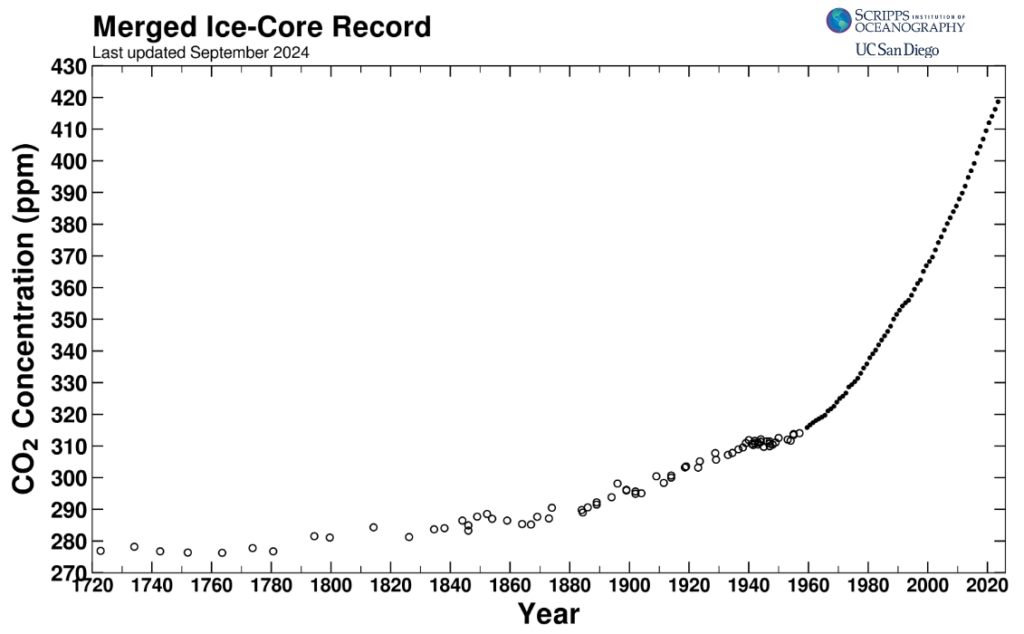
Sustainability became a growth stimulus and is one of the oddities, making things popular, efficient, and easy to multiply, with great social support. So, those efforts both failed on the one hand despite the dedicated efforts and also backfired, profiting the dumb system that didn’t know when to quit for threatening its existence, too. You can see that plain as day in the CO2 curve below, not a ripple of hesitation in the CO2 growth curve, just as if *everyone* was strongly in favor of it.
So, it seems to be time to look at the whole problem from a fresh point of view and start sorting our choices.
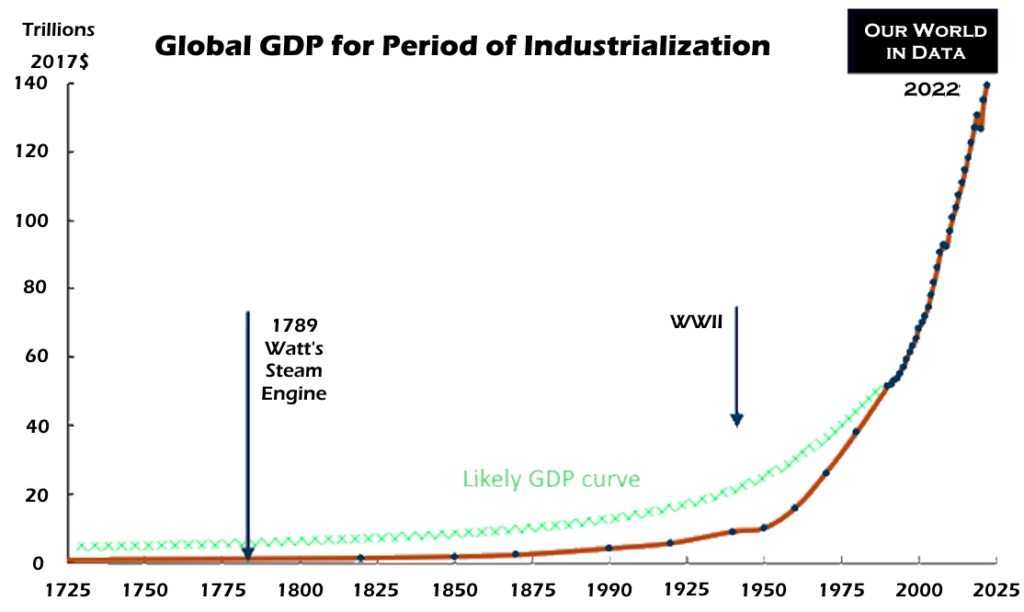
The current world measure of atmospheric CO2 (the main source of the exponential climate heating crossing the thresholds of lasting harm we’re now experiencing). – The trend is closely proportional to world GDP growth from 1971 to the present (7), with CO2 growing at ~2% a year since WWII and GDP at ~3.5% a year. – CO2 Data – Scripps: https://scrippsco2.ucsd.edu/data/atmospheric_co2/icecore_merged_products.html
II. THE SYSTEMS THINKING WE ALREADY KNOW – I’m a senior natural systems research scientist who’s been trying to shed light on some of these fundamental errors of perception that seem to be at the core of our modern world’s struggle for survival. This approach originally came from noticing gaps in physics, you know, the kind that shouldn’t be there. But it took many years before I had the beginnings of a clear idea of what to do with them. One of them was the reliance of physics on math, which meant the field had no way to study how things began and ended.
Let me explain. Scientists, not nature, define scientific equations. So, equations of change over time would trail off to infinity unless someone defined them to begin and end at a particular time or change abruptly by a scientist’s arbitrary choice. The same goes for economics, the math for our life support system! This is part of why it’s not working when, indeed, extrapolated to infinity.
Both of those illusions of math seem to come from the many centuries of our public lives relying on increasingly rigid thinking, like abstract rules, when nature presents us instead with highly varied kinds of resilient, lively, flowing systems of working relationships that themselves evolve into and out of existence. Empirical systems science is then a study of reliable but not rigid understanding. So it is also a little more focused, but not so different from what people do every day. We all spend our time looking for one after another sign of change or opportunity, or of what may be approaching, reading and getting a feel for the contexts for changing relations.
Doing that scientifically means asking key questions and looking for specific signals and patterns, more record-keeping, exploration of more related contexts, the added boundary testing and careful feeling for surprises, hoping not to be blinded by assumptions, reading situations, playing with hints of irony, and following up to confirm possible connections, all the fun mental journeys that help us get along. So it mostly works in context but also alternates with simplifying patterns to abstraction, not to follow, but like symbols, as handy guides to the questions that come up at different times. So, in that way, it’s the oldest science of all, what we as a species spent time learning from for the last million or so years as humans began to rely more on reaching for the limits of information, art, insight, connections, and feeling. The pace of that learning greatly accelerated around 60 to 100 thousand years ago, as we discovered how to form reliable language, with sounds that pointed to things and patterns in nature to our feelings and experiences with them. That “genome of language” seems to be what made it possible for all languages to collect and share useful meanings for the same things and translate them from one language to another.
Had language just been an accumulation of popular hearsay and heresy, as much of language seems to be becoming today, it would never have become such a very useful way of storing, comparing, and improving on useful insights, feelings, designs, values, and ways of working. The surprising thing today is that in so far as nature is still here, the forms of language that so effectively connected our minds to nature are, too, just sometimes hiding in the root meanings of the words we use all the time, still there, just never cut from the branches and trunks of natural meaning they grew on. While their natural meanings do “have definition” and are related to others. ”Their meanings” are “not defined,” though, in the sense of being fixed by some rigid specification. Instead, they are recreated again each time we learn from their rich histories of usage, like new flags waving what we all find in the commonly recognized aspect(s) of nature they point to.
Do you have a podium? What do you think humanity should do now? We’re mostly very nice people, but we do not know what we’re doing. We always want to find out, though. Other people need to hear what you really think if you can find a way.
_____________________________________
III. THE MEANING OF OUR OLDEST DREAM – What seems to be one of humanity’s oldest hopes and dreams is for there to be some great force of good to call upon as if we still had our parents to rely on or a God that might step in if problems got bad enough. We do experience the natural form of that in all the systems that we are part of and that we interact with. The word “system” came originally from observing things that held together and have experienced real “unity” and “cohesion” when part of something powerfully good for us.
Many kinds of natural systems that hold together are also organized to care for all their parts. Our healthy minds do that, and healthy families do that, too, as do friendships, organizations, and communities. It’s how things that work well work. We always like it and are happy to take part in it, but the world we also made seems driven to be at war with itself and nature, against nearly everyone’s wishes, but we just don’t see why. We might have thought we were living peaceful lives, but something seems to consistently blow things out of proportion, inflaming conflicts inside and out.
There are exceptions, but that’s been happening for at least five thousand years, and mostly for the world’s most productive cultures, starting with what seemed like wonderful traditions, leading to their terrible entire societal collapse. That kind of collapse also erases what it was that collapsed, as the tower of Babel was recorded only as disunifying the multiplication of languages and fragmenting culture. Both the Greek/Crete “Atlantis” and the Roman collapses came from the great success of intelligent, egalitarian, caring, and creative cultures, only to vanish mysteriously, of course. That’s what’s currently straight ahead for us, too, as our global system of stimulating human creativity led us to fight with and exploit each other as we destroy the only habitable planet we know.
Part of the secret is that Growth systems self-organize to work as a whole AND double in size and complexity again and again till something changes them. If they fail to find how to cooperate, nature erases them. From the smoothness of the economy’s global curves, it is clearly working as a whole, coordinating its parts. It’s regularly doubling its scale and complexity, as well as the suffering and conflicts between its parts while degrading its environments. If it is working as a whole, then why isn’t it taking care of all of its parts? It seems to be taking care only of the forces pushing itself and its environments over their last thresholds of growing instability, conflict, and exhaustion. It’s a failure as far as nature is concerned and approaching the time to erase itself.
All systems are self-organized around how the parts smoothly fit and cooperate. The long-term economic curves show how effectively increasingly educated people all over the world are working together, totally unaware of what they are now working on. To grow, systems naturally design themselves to work as wholes, smoothly coordinating AND responding to changing conditions to stay out of trouble, all that is 99% hidden from view. That natural self-coordination comes along with the system as it changes purposes, too.
Any growth system has to change purposes, though, something no one has discussed yet, it seems, either to keep multiplying and stop responding to the suffering and dysfunction it creates or the healthy way to respond to limits to multiplying, turning the same resources to new purposes, to make sure it doesn’t stop caring, to perfecting its designs and making a good home in a stable environment, … i.e. what we all did when “growing up.” Civilization just made the wrong turn.
Look around. All sorts of new lives successfully transition from emerging to maturing; some quite smoothly, and others struggle, sometimes getting the help they could use or not. “Transformations” rely on chains of reactions between the parts as they interact to their “reading the signals,” sometimes like automatic reflexes, other times as explorations of new territory, as they find and change directions – the whole system steering we see everywhere things work.
We’ll need to collectively master that to survive on earth. It can go in alternating phases of experimenting and maturing, as the course of an education or career does. It’s in growing up that any system finds itself and its freedoms.
Making life work for all our world’s parts is the trick; creating a kind of hologram of every part represented in its best way to serve the whole, as the natural goal for systems able to steer is what we’d need to focus on for some time. The role of the parts is always to share and learn, notice good, bad, fresh, stale, and other kinds of useful and enjoyable ideas, to “get the signals” to “step up” or “take off” to reorganize our way of life, follow the paths of all successful new living systems, moving from multiplying our designs to fulfilling them. It’s not erasing the primacy of creativity but finding its right place, taking part in the new focus on caring for and perfecting the many designs of existence that every beautiful work achieves.
For either kind of growth, it is how the system steers that takes it where it’s going, responding to internal and external signals as navigation, so the system’s profits to enable it is changing lasting purposes if we want our two hundred thousand years or so of accumulating wisdom to survive.
(2022). Holistic Natural Systems – Design & Steering: Guiding New Science for Transformation. Journal of the International Society for the Systems Sciences. Presentation Jul 9 https://synapse9.com/_ISSS-22/HNS1-MS-Design&Steering.pdf
… There are so many signs… It’s something everyone should be asking by now. Everyone’s experience of accelerating change is indeed unprecedented, except during periods of dramatic historical change, notably marked by an absence of vision for where we’re going, so many kinds of change seem clearly irregular.
I grew up in an exceptionally peaceful little village and somehow became an accomplished natural systems scientist, coming from a family of scientists and educators, and events later motivating a search for what sense I could make of what seemed to make none at all; noticing what you might call “gaps in the story” that begged for answers. That led to a fascination with various things science seemed to pay no attention to at all, one of which was the intriguing question, “What makes life so lively?” Physics says everything is running down, somehow without begging the question of how things must also have started up, many of which build up and up for long periods.
My first hint of all that turned up when watching a physics lab demonstration commonly used as an introduction to the field as a first-semester freshman. A strobe light was turned on, illuminating a ping-pong ball tossed from one end of the demonstration table to the other, recorded as a dotted curve by a time-exposure camera. The ball is pulled by gravity, and the equation for the curve is a simple parabola, which one can mentally deduce from the distances between the dots, representing the flight of the ball, a simple bit of real magic made by turning something very common we all see, quite unaware of what we’re seeing, suddenly illuminated in our minds by an unusual perspective.
In such cases, a class might respond with silence, and I thought to fill the silence with a silly question, asking, “What about the tossing and the catching?” The tossing and catching were missing from the demonstration, and not in the formula, produced by bursts of energy and animated coordination of hand and eye, first to release, then catch the ball, so it doesn’t bounce away. That we never talked about those parts of the experiment stuck with me, though.
I got a little laughter from the question, but then it took several months till I realized I’d stepped right into a very deep void in physics. Physics does not have a way to say what “happening” means, for example, or a vast array of other things our everyday words refer to. Physics has no way to explain any kind of beginning or ending; in fact, it just lets its equations trail off to nothing, without reason, which rather shocked me as an odd thing, given that the laws of physics are always portrayed as the laws of nature, and apparently just were not at all.
Isn’t that nice?
It seems that every kind of observable behavior also has an inexplicable beginning and end, lacking any formula, though our own intuitions readily fill in those little gaps in the science that turn up everywhere. The gaps in formulas can often be estimated, though, guessed at to give a little time for responses to develop, predicting when and where things will begin or end.
“Who cares” seems to be the practical response, of course. All that often matters is how things end, not begin, and approximation is all that’s needed if large parts of things can be accounted for. There’s a bigger reason to be concerned: science has largely lost interest in how things begin and end. It has to do with why all of life is inherently lively and incapable of starting or ending anything without being creative.
It’s that the beginnings of things always require new kinds of organization in working processes… usually requiring a growth process, which science failed to recognize as more fundamental in nature than the equations that give people power over what we wish to change. That emerging systems-in-formation are generally hard to see, as the change is, as yet, unformed, is another part of the puzzle. We don’t “see” their forms till they’re developed, much as one doesn’t see the adult when introduced to the child.
So, formation processes are needed all over, are mostly unrecorded and unexplainable, and are known only through the implications of the changes they enabled. They “seem” to come from nothing, but only virtually nothing, as it is also quite clear that emerging designs emerge from the contexts they are found in by a local self-organizing process, things set in motion as emerging forms that develop in relation to their surroundings and their capture of energy from their environments to do it. It took a few decades to validate the physics behind it. Still, I guess, naturally, it was generally dismissed as uninteresting too, to find quite essential working parts of nature that physics completely ignored! Thought to be uninteresting!! That did not even change when it became clear that what’s hidden in the gaps of science is the set of processes that connect more visible things. The equations that serve as the “standard forms” of nature physics have done such brilliant work, exposing still, it ignores the singular and uniquely emergent ones, causing physics and many other fields to lack curiosity about what is really happening, for which we may all be as profoundly sorry as one can be in short order. The formation of nature’s formulas has no formula, as THAT still appears to be what’s “happening,” especially when we see things going terribly wrong.
I grew up in a multi-generational physics family. I was encouraged often enough to “look around” to see the world as being in motion, not just composed of individual questions and answers. It was thus that the general view, combined with my initial observation of a glaring gap in its application in physics, eventually led me to discover that “every formula needs to develop in the context in which it takes place.” In context, of course, that “big idea” is not much more than how every response to life develops in relation to its particular time in history, place, and context of environmental relationships. Of course, the question of how many levels of working self-organizing relationships are needed for anything to happen is rather daunting. It seems what matters is remaining curious and finding one’s comfort level with what you find interesting.
What came to be most shocking to me, though, was not how physics left little gaps where nature’s connecting parts were, having just failed to notice, but that the beginnings and endings of events are generally the formative processes of the self-animating systems, often resulting in Important lasting changes of design, or the opposite, none of it like formulas. So, it’s the difference between our lives of active relationships and the formulas for profit: night and day. It creates the ever-growing tension between how we make a living and how our most precious rights and freedoms will survive.
Yet, still today, humanity remains unified in pursuing the long-term, regular doubling of business profits and the spoiling of the earth’s habitability. Why wouldn’t we notice that being unprofitable?
Do all our institutions and cultures tolerate the apparent grand collective suicide-mission that business and finance are on? Or are they all just waiting for the right time to turn to other business than growing ever faster to only collapse and be erased by nature’s also efficient methods of doing that? Why have we designed our lives around skimming societal profits to concentrate them in the hands of people who have yet to see the feedback loop of caring for what supports you to continue being supported?
It entraps everyone in taking power over nature until we destabilize it, a decidedly unprofitable general plan. The old rule is “look around.” Why don’t we do that? There are many better ways for large organizations to live on earth, such as growing to fit in and serve rather than blindly to conquer. Is it ONLY that finance is set up to support every attack on someone else’s success? That does seem to be part of it; that finance is NOT building collaborative systems at all, but multiplying suicidal systems. Might finance make a lot more money investing in things that are more useful than that? It’s the exploratory fingers that put things that work together to work better, not automatically multiplying the threats.
If we could just turn it around the way natural growth does, coupling the bursts of growth with dedicated homemaking, rather than bigger bursts of threats… Could that be a plan?
Jessie Lydia Henshaw Synapse9.com/signals Natural Systems Design Science
Ideally, we should talk. I’m an accomplished senior natural systems scientist who has been decoding the “weirdness” of our world’s suicidal head-on, breakneck accelerating collision with the natural world for 40+ years. I began as a physicist, and when I discovered that physics has no explanation for organization, or particularly how organizations begin and end, I realized all of physics is made of shortcuts for manipulating things we don’t understand, as its source of funding. I checked the history… and yes physics was founded on the demonstration of that method by the first scientist, Thales of Miletus, showing that equations can be used to time purchases in the Greek olive market to make a financial killing.
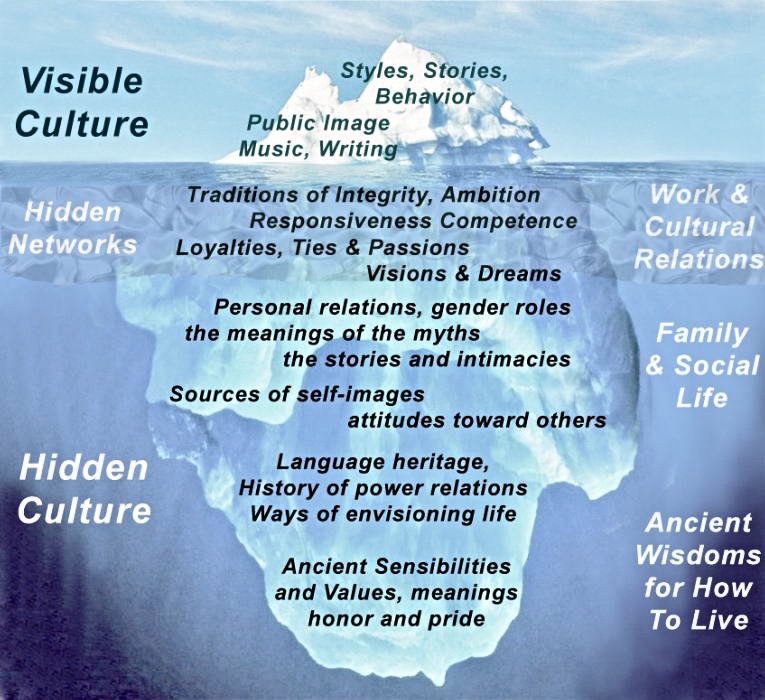
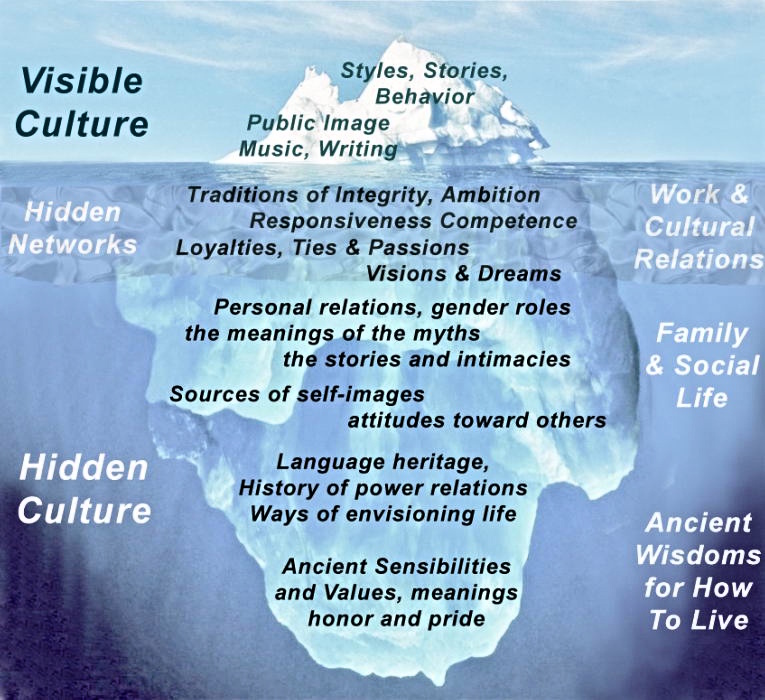
Fig 1. Shortcuts and Wisdom – with deeper and deeper layers
Contrary to its image, science became the workshop for driving economics, using the profits from research to multiply the research and keep growing with ever doubling profits. All the time the method uses only abstractions, taken out of context to simplify the work, and so detached from its contexts of local system organizations that give anything in them their primary meaning. The modern world’s separation from nature that it greatly adds to is much older, but multiplying our control of nature with abstractions taken out of contexts of nature surely adds quite a lot.
So… as a result of their design, whether intended or not, the design of theoretical; science without contextual information about the working contexts of nature, makes physics and economics appear to have no natural limits at all, that is until your civilization starts to collapse, as we’re now experiencing, as the only indicator available to the natural limits of a limitless growth system in nature, a kind of QED!, affecting directly affecting the two most important fields of science we use to steer the planet. It’s not that we couldn’t make some corrections for that, the best would be to use the abstractions to help us see how very different nature’s complexly layered designs and self-adjusting designs are. It’s removing nature entirely from the picture of science that seems to be the cause of the current head start to a general civilization collapse to rival those of the past.
Given how powerful and profitable simple rules for controlling nature are it seems five millennia or so of human cultures favored the simple abstract rules of power and ignored the horrific complications from which they would develop. Made blind to the internally and externally responsive designs of nature, the designers of abstract rules would hear and see things in the cultures around them that lived by nature’s rules and have no reason at all to think of going back to those older forms of knowledge and wisdom.
However, various anthropologists, who worked more like archeologists, sifting every layer, began to study the three great and prosperous civilizations that appeared to have collapsed from being too prosperous, like we are too, (#1 Babel, #2 Bronze Age Atlantis, and #3 Rome). It seems inevitably, that if ruled by unnatural laws… “something else always happens on the way to the Forum.” Economies designed to multiply without limit do naturally destabilize their internal cultures and explode in contradictions.
At present, in our case, growing inequity between the layers of the working and wealthy households remained at least proportional; to their long stable relationships up to the end of WWII and the general “update” of capitalism that would follow and spoil the day. Profits began to suddenly concentrate only at the top and failed to filter down as before, from a change in competition at the top it seems. The growth of the American economy, put in place by decisions of the SEC, heavily favored wealth concentration at the top, in the financial world and its shareholders. Apparently, they saw no reason not to take virtually the whole pie for themselves, not realizing the peace provided by the prior pattern of trickle down that kept the society unified, and the new one would take power over the steering of everyone’s world to maximize profits at the top.
As in the Bronze Age Collapse (if my reading is correct) that resulted in such outrage from the bottom that it occurred to the working layers of the economy they could do better without the top, leading to collapse not reversing the order. As decision making had come to be based on the abstractions favoring each community separately, they both made great plans blind to all their contexts that, at the limit of growth for the whole, would rapidly tear it apart.
So, This is the societal sequence of events that takes us to the point when and where the gaps of connection become wide enough and the legitimate but uninformed grievances and resentments become extreme enough allowing a civilization to become prone to takeover by hatred and vengeance seeking cults, driven to their desperation, like our so called Christian-Nation and its legitimate but misunderstood grievances, choosing all the wrong solutions and people, like teaming up with the similarly resentful member of the super-rich as a “savior,” Mr. Donald Trump, still sore from not being accepted in polite New York society.
Cette la Vie! What happens next is the killer. With the divergence of once shared interests continues, segments of the cultures split apart economically that once mingled amiably. becoming enraged and at each other’s throats instead, starting tp smash things for the pleasure of insulting the evil images of the folks they have come to resent for doing them harm, even if almost totally misplaced. The actual harm may be coming from their own leader, one of the super-rich causing the demise of good working-class life. For the dispossessed and their leader orchestrating the destruction of the cultural assets of America’s once commonly celebrated culture, is more than a terrible shame. Somehow the smashers never realize that if they smash the working connections there won’t be anything left for them either.
That is what we see in rough terms today, Trump rewarding the vengeful resentments he has fed in his base, who will help him retain power, but who will not be helped at all by the severe damage to the society he and they are attacking and blaming for the oppressive working class exploitation that their leader had a big part in, as all power players who in a panic honestly seem to become blind to their own roles in alienating the parts of society they most depend on.
What Trump says he is offering to the resentful roots of Middle America, that he fanned into flames to serve him won’t be delivered. They just served him by letting him take control of congress and the courts, using a great misrepresentation of who was responsible for their very legitimate complaints. They were left behind by the business world, because of the “fast money” produced by the “Shareholder Value” plan of the super-rich… most of whom if memory serves were extremist Republicans.
They are nearly all like everybody else now, just wanting their old world, or something like it, back. The Trump program of smashing the working parts of America’s once unified civil society and common culture, only assures he won’t be able to help his own resentful base. Dismantling the workings of a system to serve the people won’t help anyone at all, in fact, what also did happen in the Bronze Age. You’d just never get it back. But is this a moment, of having had a taste of it, we should now know what’s wrong with politicians skillfully weaving resentments into hatreds for them to exploit — and walk away. No one ever needs that again, and history is so full of that very evil. Hate is not helpful at all.
What you’ll need is the original dreams revived, with “some midcourse corrections,” for sure, and a long effort to keep learning about what happens when you seriously mess with a real good thing. We could still have the American national family plan, I don’t think. That isn’t worn out yet, that plan to heal the wounds, start caring for the planet and all the vibrant cultures we admire, respect and love as part of our home.
It seems our natural confusion about nature is quite natural. We are part of nature, but we behave so differently, seem so powerful and talented, yet have kept making huge mistakes throughout history. Is there a way for us to live “normally” and not keep having to make such lasting trouble for ourselves?
__________________________________________
One of the noticeable common patterns in both human and natural behavior can help us see the hand of nature, or God, if you prefer. Both our bodily and mental behaviors are energy processes, and in one important way, like all observable behaviors, they are alike in how they begin and end
Their changes all begin and end with long or short chains of “emergence and convergence,” as local system “startup and finish-up” processes develop and subside, allowing nature to build up and taper off its energy system designs. They’re necessary for nature, including for our bodies and minds, but may only be visible from the pervasive, smoothly connecting S-curves of change that are found everywhere in nature.
S-curves of Change, periods of emergence and convergence: All observable events begin with a period of cumulative compound growth, simply because nothing can start from its top rate of change, but has to start slow and build up.
Those common features are parts of the solution. The great problem facing humanity is that as we separated ourselves from our animal experience, we also lost much of our once considerable ability to intuitively read what was happening around us, from our senses responding to the changing directions of these natural curves; symbolized above.
We still feel the sharpness of movements when traveling, sometimes signaling emergency needs for preparations or, the opposite, “that everything can relax.” We have thousands of words to describe these informative connections with the natural streams of information from the behaviors of the world around us. What would you do, for example, if great nations suddenly and rather wildly began heading off in unexplored directions?
It could happen, and it just did!! So, for as long as one can keep close to things that will still matter, the continuity of life and our connections with each other will be maintained. We also lose connection with how our world is responding to us by “making up stuff” about what’s happening, in place of “observing and feeling stuff.”
It seems not too hard to reeducate one’s bodily feelings that would normally respond to environmental signals of change, like feeling a hesitation is someone’s response to you, sometimes good to verify, sometimes better not to. It’s this way of being alert to what’s happening in a way that revives our original way of feeling our way along, reading the world as in step with our understandings, that will be key to successfully restoring a little comfortable order to the Earth again.om how they push one way or another, feeling comfortable or increasingly uncomfortable as “signals” from nature we feel in our guts.
What seems to have created a deep deception for us is that we started making up our own realities… rather than learning how falsely simplify our view of nature, we have generally represented those creative periods with equations, **erasing** evidence of their emerging processes and the contexts they emerge in, permanently blinding people to the organizational complexity of how nature works!
In effect, that choice represented all of nature with business models for how to interfere with nature for profit or to “buy low and sell high” in the business world.
The turning point in the history of mankind’s struggle with our own false self-importance –the only way to put it – came during the recovery of civilization, ~600 years after the Bronze Age Mediterranean civilization’s collapse from it. It was the emergence of science, from the great innovations offered by Thales, that formalized what we call “the growth to collapse model” for very creative, yet certain, civilization development to self-destruction.
It’s only a fairly firm research opinion, but science may have developed by combining the creativity of two earlier groups of Mediterranean cultures, group A) the marvelous design abilities of earlier Egyptian, Cretan, and Greek cultures, and group B) the Babylonian and Hebrew cultures that focus on abstraction and absolutes, providing the mathematical foundation for sysematicly empowering group A. That, unfortunately, also organizes modern civilization science designed around a business model for endlessly multiplying its power. Anyone could see it would not last, but for self-important people, it is often too captivating to resist.
The fatal flaw would not be noticed for a long time, as the highly profitable but faulty change in Mediterranean societal leadership from connecting group A design cultures focused on natural designs (which give warnings of destabilizing limits) and Group B cultures from the more unforgiving Fertile Crescent and Middle East, focusing on statistical rules that easily project to infinity, which tied to even forgiving natural environments will fail before the get there.
What caused the amazing productivity of these partnerships to end in utter disaster was probably discovered by many, but was put down again and again as social forces, as they so often do, for lack of explanations, and disoriented by their proven formulas for success terribly failing again and again, blind to the role of contexts.
Even today, society’s commitment to maximizing growth **without concern that the growing instability of ever more sudden change** (the actual symptom we’re experiencing that we feel as being jerked round) may not have a good chance of settling down as our growth systems turn to relieving strains and perfecting their designs, on the path to surviving our period of ever faster growth.
So,1) given humanity’s often misleading feelings of self-importance and 2) our deeply entrenched cultures committed to growth, we could collectively see the advantages of finding how to care for what we made, or keep bickering.
___________________________________________
JLH 2025-06-10
New systems science, how to care for natural uncontrolled systems in context