rec
rate
topic
A Common Sense of Natural Systems
11/23/08
1
alternate accumulating steps
It also turns up in the alternation of exploration and testing, for example, in any learning process, as well as in alternation of learning and understanding. Those two examples involve more complex and overlapping alternations, each is equally essential and opposite in the role it serves to the other. That aspect makes it look like a 'corollary' of the religious principle of yin and yang, but a feature of the functional world of natural development. I think learning the functional meaning of it is likely where the religious principle came from originally, and as with many religious principles, represents ancient scientific discoveries that later developments in science had no way to incorporate.
12/22/07
W
1
when energy flow multiplies
the eventfulness of natural events
a 'gust' of wind,
a 'flicker' of a flame
any new set of relationships arising from its own environment
The common explanation is that new natural systems begin when an organizational short-cut for moving energy multiplies as finds more opportunities for it develop more and more easily. Then as the larger opportunities end in successively smaller ones it either come to an end or stabilizes as an individual .
It seems to take developing a new systematic process to begin or to end a flow of energy.
To develop a process needs a 'seed' of events at a smaller scale, and to multiply. It's part of the local animation of inanimate events and processes.
Phrases referring to systems taking a ‘short-cut’, or 'exploring' or ‘finding' 'opportunity’, or being an ‘individual’ are words meant to be defined by the natural phenomena which display an intelligent design, without a designer. They're the easiest way to refer to kinds of change that develop independently in relation to local circumstances, needing to be clarified as not referring to our own imaginary explanations.
This provides a way to ask questions about organizational change that can be seen as originating from growth and ending in decay, the things of life that are relatively simple but mysterious, a 'gust' of wind or the ‘flicker’ of a flame, as well as complex things such as economies and organisms.
Some parts of change are controlled and predetermined by others. This is about the uncontrolled change,. usually involving diverse and widely distributed behavior, starting as little ‘short-cuts’ that grow and develop as a whole.
12/07/07
W
2
systems are things
a transition between before & after
Natural systems are something like machines in that they are physical things with locations, identified by their internal cell of continuing circular relationships, and the accumulative processes by which they developed, using energy.
1. They have ‘mechanisms’ of various sorts, though frequently their ‘parts’ are not rigidly connected. There are other continuities to watch for what is connected change energy from one form to another.
2. They’re very different from machines in that their designs develop on their own from a ‘discovered’ opportunity within an environment, and are always fluidly changing.
3. Sometimes their
continual changes are more in relation to themselves, sometimes more in
relation to their environments.
· machines and equations and fixed
rules can’t don’t build themselves or change their designs in relation to
their environments.
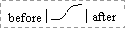 4. Change in natural systems takes a process of changing, so when there’s an
organizational difference between ‘before’ & ‘after’, it’s likely you’ll be
able to find what opportunity for it developed by successively larger and
then successively smaller steps.
4. Change in natural systems takes a process of changing, so when there’s an
organizational difference between ‘before’ & ‘after’, it’s likely you’ll be
able to find what opportunity for it developed by successively larger and
then successively smaller steps.
5. natural systems have many of the same natural limits as machines. They begin and end, use energy in irreducible amounts, and can be stressed to failure.