These pages ... began in 1994 as a collection of experiments in displaying the shapes of unique mechanisms of change, using a mathematical method loosely called derivative reconstruction (DR). The real beginning was long before, in the 70's, having to do with studying evolving systems of convection, and needing a way to record, display and describe it. Shapes of change, where you can find them, are stand-in's for differential equations defining complex behavior, displaying unique individual event and process structures.
Some progress in various directions has been made, some recorded here, some in other writing, and some in the related techniques by others, only recently found. There remains a barrier though, that just too few people seem to 'get it'. Maybe it's just the common hubris of believing that nature is math. This leaves these pages as a collection of artifacts, in various states of development, reflecting different periods of a changing work, i.e. a little disorganized. Other experiments and discussions of things of current interest, like the ideas that originated the work, may be added.
One recent turning point was finding a new way
to use ordinary running averages, smoothing away a curve's shapes entirely
while tracing the turning points in the curve to see when they disappear.
The preferred kind of running average for this is a bell shaped weighted
average called a Gaussian 'kernel'. For simple application the points
must be equally spaced for repeated averaging to regularly reduce the number
of turning points. This provides an easily understood way to display
the various scales of structure in individual events.
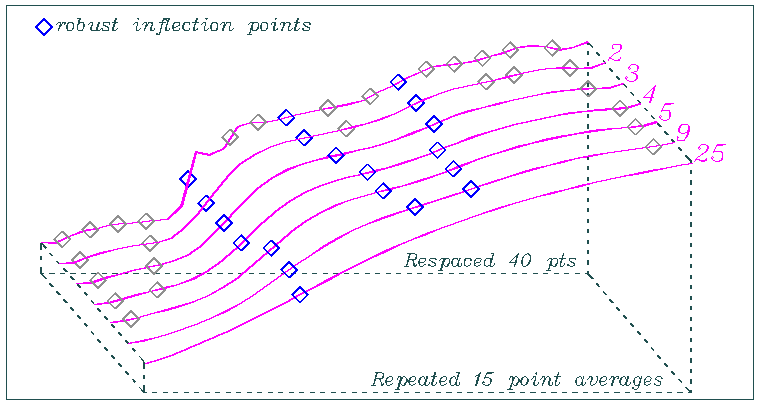
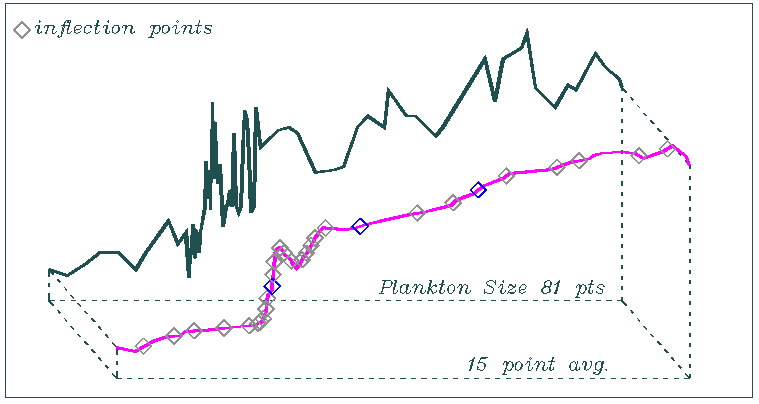
The example at the left shows a change of plankton size over 6 million years previously studied using DR, the Malmgren data tracing the transition between G. plesiotumida to G. tumida from samples collected in a deep sea sediment core. The blue diamonds are the turning points that remain after several smoothings and can be traced back to the original shape to see where the original changes in direction were located. A little more on this is available in paCSS.htm.
This method originated with work in curvature scale space (CSS), for computer vision. The method of Farzin Mokhtarian allows computers to distinguish the shapes of objects by matching their outlines, according to the turning points that remain after successive smoothings. His group has composed a marvelous web page of demonstrations. There's a good bit of other interesting work in the area, such as Tony Lindeberg's, and there was a major conference in summer of 99, Computer Vision & Pattern Recog. 2000, and a wealth of other methods for generalizing and classifying shape in the larger field of pattern recognition.
DR provides a different way to find these same scales of shape, often with less distortion. DR and CSS differ in the types of data for which they are best suited. DR might be preferred for studying subtle shapes in sparce data with little noise and CSS for more plentiful and noisy data. Hopefully publication of the basic techniques in IJPRAI 12/99 with result in leading to a more powerful mathematical treatment using the best of both methods.